
Saudi Off-Plan Purchases: Check the Project Licence and Escrow Instructions
Check project identity, the scope of official permissions and payment instructions before an off-plan commitment.
Read more →
Connect the exact unit, official project records, contracting parties and payment documents before buying off-plan.
Project checks are most useful when they follow the offer you are actually being asked to accept. Begin with the exact development, phase and unit, then connect the official records, contracting parties and payment instructions to that identity. This section organises those checks for a Saudi off-plan purchase. It does not rate developers or endorse projects. A company can have an extensive presentation while important questions about a particular unit or agreement remain unresolved; your file should make those questions easy to see.
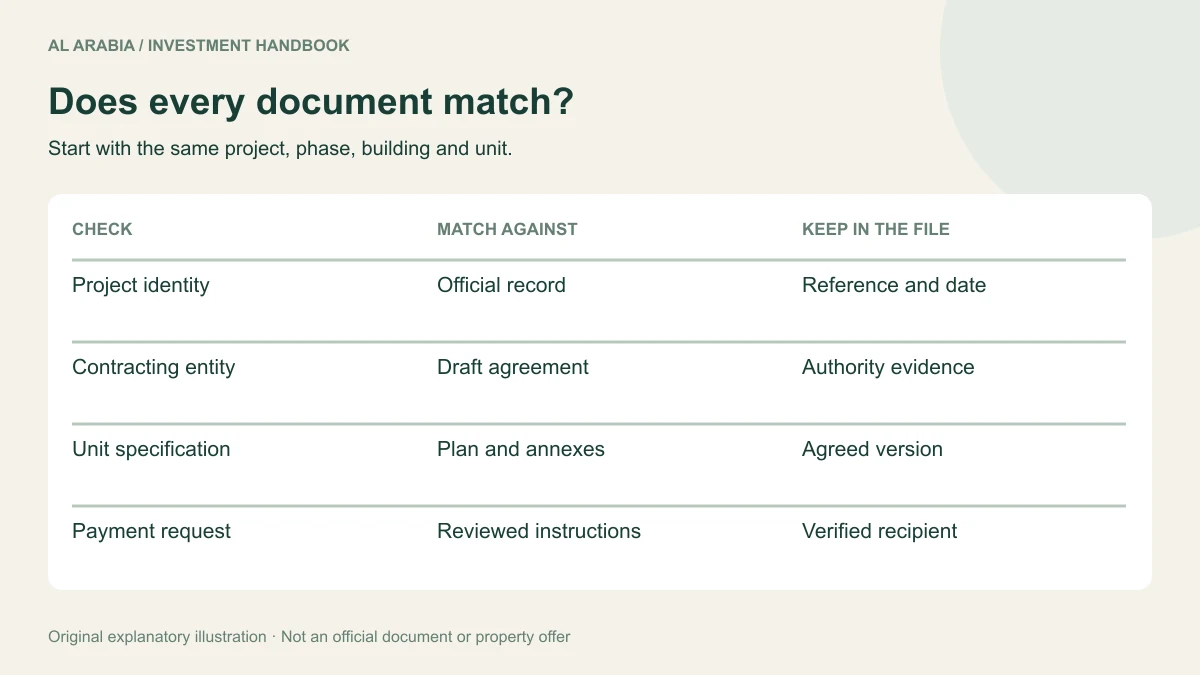
Record the project name used in the agreement, any public marketing name, its location and the identifiers used in official records. If the development contains several phases or buildings, specify which one contains the offered unit. A licence or document referring to a neighbouring phase is not automatically evidence for yours. Ask the provider to explain different names and retain the explanation with documents that support the relationship. Do not guess that similarly named entities are the same legal party.
Create a one-page identity sheet that links the proposed purchaser, contracting seller or developer, project, building and unit. Add the reference for each supporting document. This sheet is not an official certificate; it is a practical way to spot contradictions. For example, the booking form might use one unit number while the plan uses another. Resolve the discrepancy in the transaction documents before allowing it to spread into payment records and correspondence.
REGA's official off-plan services and procedural guidance are the starting point for checking project permissions. The activity described in a record matters. A marketing permission should not be treated as though it necessarily authorises every form of sale or payment collection. Use the relevant official enquiry or obtain clarification from the competent authority when the scope is unclear. Keep the reference, the date checked and the result, rather than preserving only a cropped image of a licence badge.
Official records can change, so repeat essential checks at meaningful decision points. A check made when first discovering a project may need updating before signing or transferring funds. Note any conditions or limitations visible in the record and ask how they relate to the proposed transaction. The detailed licence-and-escrow guide separates these regulatory questions from the commercial assessment, helping you avoid assuming that one successful check resolves every other concern.
List the developer, the entity named in the purchase agreement, the broker or sales representative and any other service provider you intend to engage. Ask who is authorised to sign and which entity is responsible for the obligations you are relying on. A group's brand name may appear across several businesses; that does not tell you which one owes the contractual commitment. Have the relevant authority and entity documents reviewed where appropriate.
Keep responsibilities specific. The person showing a unit may be able to explain the project but may not be authorised to change the written agreement. A consultant may provide an opinion without guaranteeing construction or delivery. An agent may arrange communication without holding the seller's obligations. Recording these distinctions helps you direct questions to the right party and avoid treating an informal assurance as a formally accepted amendment.
If a developer supplies examples of completed work, identify what those examples actually show. Ask whether the projects were delivered by the same contracting entity, what role that entity performed and whether the comparison is relevant to the current proposal. A completed building can demonstrate a visible result, but it does not prove that another project's timetable or specification will be identical. Avoid turning a small collection of photographs into a numerical reliability rating.
For the project under consideration, distinguish official or contractual evidence from progress marketing. Record the date of construction photographs, the location they depict and who supplied them. Ask how progress relates to the payment schedule and what evidence supports a milestone request. Where technical assessment is important, use a suitably qualified professional. A buyer's visual impression of a construction site is not a substitute for engineering verification.
Read the draft agreement alongside the unit plan and specification schedule. All three should describe the same purchase. Check how annexes are incorporated, how changes are approved and how notices are sent. Flag references to missing schedules or documents that have not been provided. An agreement that refers to an unspecified standard finish or a future schedule may leave a question central to your decision unanswered.
Review payment instructions separately and verify the relevant project escrow arrangements through the appropriate documentation and official process. Record the beneficiary details and the independent channel used to confirm them. A familiar salesperson forwarding new bank details is not, by itself, a complete verification method. Do not transfer money simply to preserve an advertised incentive while a material identity or payment mismatch remains unresolved.
Create a short status table with the question, evidence, unresolved issue and next action. Use plain descriptions such as record matched, professional review pending or revised schedule requested. Avoid a green tick that hides important conditions. The table should help you decide whether the file is ready for the next commitment, not create a decorative impression that everything has been approved. Keep copies of the evidence behind each completed check.
Continue with the detailed guides on official records and specifications, then connect the resulting commitments to your purchase budget. Before signing, reconcile the file one final time: identity, permissions, parties, scope, payments and delivery provisions. If a proposal changes materially, repeat the affected checks rather than carrying forward an earlier conclusion. This approach gives you a transparent record of the decision and a useful baseline for later handover discussions.
Official references provide regulatory context. The document, budget and inspection checklists are practical editorial guidance; they are not official forms or individual approvals.
Check project identity, the scope of official permissions and payment instructions before an off-plan commitment.
Read more →
Compare plans, included finishes, shared facilities and change provisions against the agreed off-plan unit documents.
Read more →0 properties selected