Saudi Off-Plan Project & Developer Checks
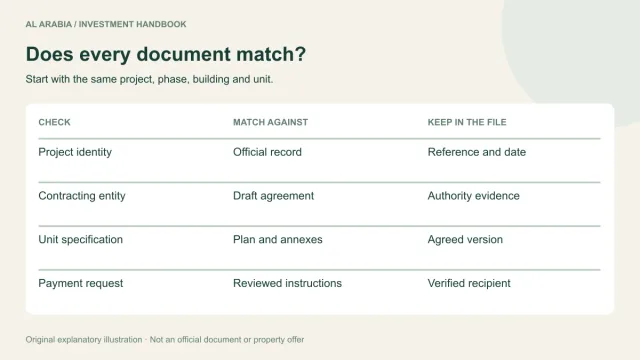
Connect the exact unit, official project records, contracting parties and payment documents before buying off-plan.
Read more →
Review Saudi off-plan project records, unit specifications, payment instructions and delivery commitments.
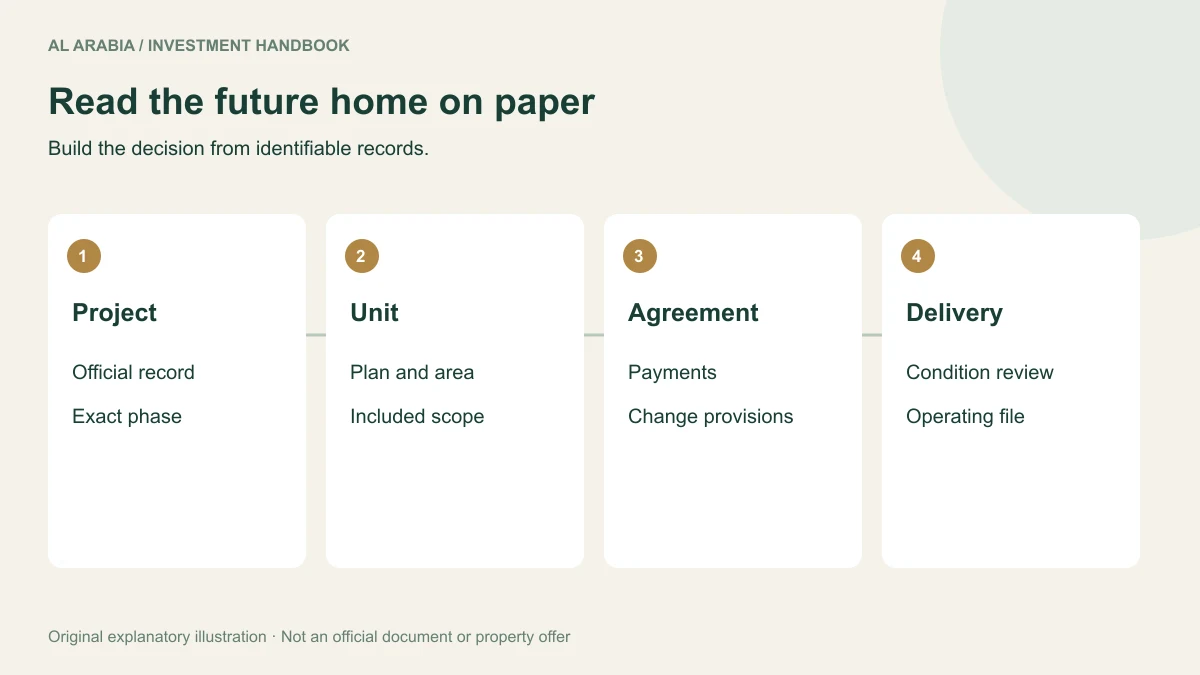
Buying a property before it is complete means evaluating a future home through present-day evidence. Drawings, specifications, contractual commitments and official project records matter because a finished unit may not yet be available to inspect. This section explains how to organise that evidence when considering an off-plan purchase in Saudi Arabia. It does not present any project as approved, available or suitable for foreign ownership. Those questions must be answered for the particular buyer, property and transaction using current records and professional advice where needed.
A development presentation may describe a wider district, future retail, landscaping and a lifestyle concept. Your purchase agreement concerns a more specific set of rights and obligations. Identify the exact project, phase, building, unit and annexes that form the offer. Ask which elements of the presentation are contractually included and which are illustrative or dependent on later development. A compelling master plan is useful context, but it should not replace a clear description of the property you are buying.
Create a document index before comparing alternatives. Include the latest plans, specification schedule, payment schedule, proposed agreement and the references needed to check the project through official channels. Record the date and version of each item. If a salesperson sends a revised floor plan, keep the previous version and ask what changed. This makes it possible to discuss a real difference rather than relying on memory of an earlier image or conversation.
REGA provides the official framework and services for off-plan sale and lease activity, including the Wafi platform. Use the official channels to establish the records relevant to the project and the activity being proposed. Do not treat a company registration, marketing permission and permission to sell units as interchangeable evidence. The procedural requirements vary by activity and stage; the exact record and its scope should match the transaction being offered to you.
The Project & Developer Checks section provides a practical sequence for recording the licence reference, legal parties, project identity and unresolved questions. It also explains why a licence check is not a complete investment assessment. Official authorisation does not by itself answer whether a particular layout suits your needs, whether the agreed terms are acceptable or whether you can meet the payment schedule. Keep regulatory verification and commercial judgement connected without confusing their purposes.
An attractive rendering shows an intended visual effect. A specification schedule should identify the items, materials and systems that are actually included. Review the two together and flag anything that appears in the image but is absent from the written scope. Furniture, lighting, appliances, landscaping and balcony details can materially change how a space is used. Ask for clarification in the agreed documents rather than relying on a general statement that the finished property will look similar.
Pay attention to dimensions, area definitions and the boundaries between private and shared space. A quoted area needs a stated basis before it can be compared with another project. Record how parking, storage and outdoor areas are treated. If a feature is important to your decision, identify the contractual reference that supports it and ask how substitutions or changes are handled. The specification guide gives you a structured schedule for these questions without inventing a technical standard.
Copy the payment schedule from the version of the agreement you are reviewing. Distinguish dates from construction milestones and ask how each milestone is established. Keep booking documents separate from the main agreement until their relationship is clear. A payment request should identify what it is for and be consistent with the reviewed instructions. Changes to beneficiary details or payment timing deserve independent verification before funds move.
Off-plan escrow arrangements should be checked through the relevant project documentation and official process. Do not infer that a bank account is the correct project account from a logo or a forwarded message. The licence-and-escrow guide explains the evidence to request and the questions to resolve. It avoids assuming that all permissions allow the same collections or that every payment described as a reservation has identical legal treatment.
Read the clauses dealing with the delivery timetable, permissible changes, delay, notices and remedies. Ask a qualified adviser to explain provisions you do not understand before committing. Keep your own practical plan for accommodation, finance and moving separate from the contractual delivery date. A buyer who needs a home for a fixed family event should consider the consequences of delay even when the development has an appealing timetable.
Handover preparation begins before the invitation to collect keys. Retain the agreed specification and all approved changes so the completed unit can be reviewed against a clear baseline. Decide whether to arrange an independent technical inspection and what access is needed. Use the Completion & Handover section to organise observations, documents, meter readings and follow-up. An inspection checklist helps record issues; it does not replace advice about acceptance, defects or contractual remedies.
Before moving ahead, review the open questions in one place: buyer eligibility, official project records, unit identity, written scope, payment instructions, finance conditions and handover expectations. Assign each question an evidence source and a next action. If an answer depends on a professional opinion, preserve that advice with its assumptions. If a record cannot be matched to the proposed project or payment, resolve the mismatch rather than treating it as an administrative detail.
Continue through Project & Developer Checks, then the two detailed guides on licence and escrow verification and reading specifications. Return to the purchase budget before signing, because an off-plan schedule can distribute payments differently from a completed-home purchase. The objective is a purchase decision supported by identifiable documents and realistic personal planning, with a clear record of what remains uncertain and how that uncertainty affects your choice.
Official references provide regulatory context. The document, budget and inspection checklists are practical editorial guidance; they are not official forms or individual approvals.
Connect the exact unit, official project records, contracting parties and payment documents before buying off-plan.
Read more →0 properties selected