Saudi Property Purchase Budget & Taxes
Identify confirmed costs, applicable tax questions and payment dates before committing to a Saudi property purchase.
Read more →
Use a clearly labelled fictional example to plan the remaining price, transaction costs, funding and ownership reserve.
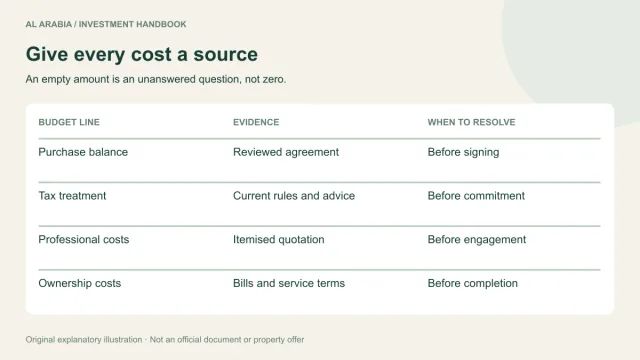
A completion budget should tell you more than whether the purchase price fits your savings. It should show the remaining commitments, the evidence for each amount and the date or event that makes payment due. This guide uses an explicitly fictional example to explain the method. None of its illustrative figures represents an available property, a market quotation, a lender offer or a prediction of costs. Replace every example with the figures from your own reviewed agreement, invoices, professional advice and current official requirements.
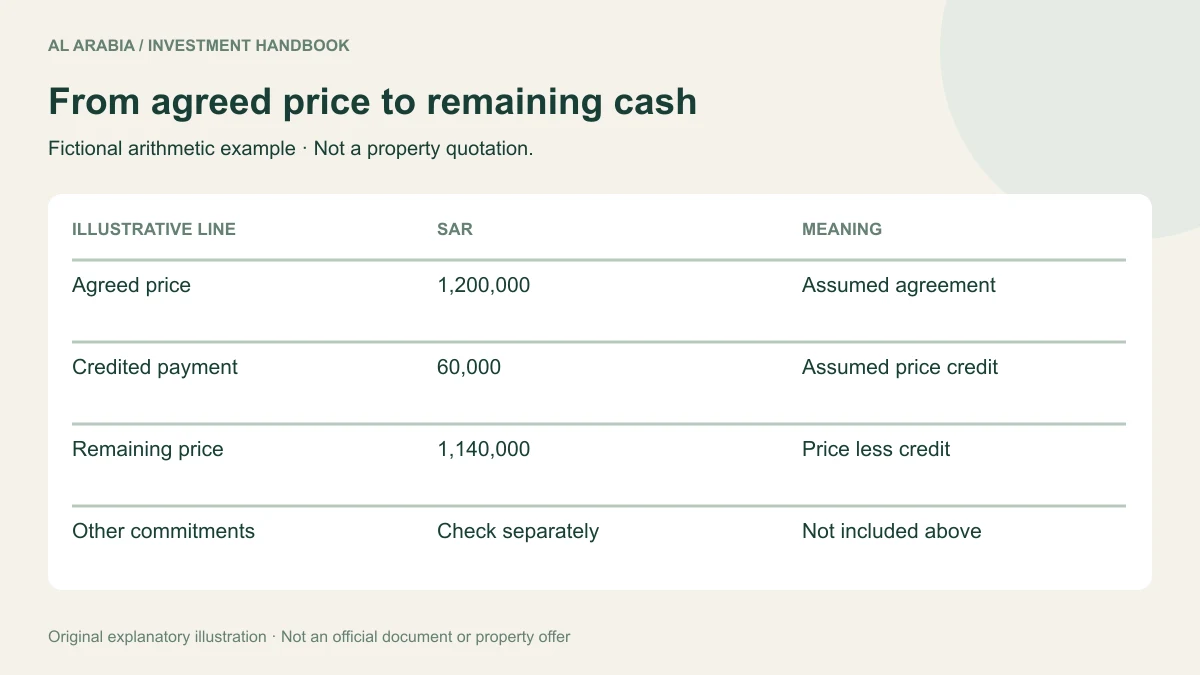
Create a header identifying the purchaser, property, currency and agreement version. Enter the agreed price rather than the earlier asking price. In our fictional example, the agreed price is SAR 1,200,000 and a documented SAR 60,000 payment is credited towards it under the assumed agreement. The remaining price is therefore SAR 1,140,000. That subtraction works only because the example expressly assumes the earlier payment is part of the price. A separate service fee or refundable holding arrangement should not automatically be treated the same way.
Beside the calculation, record the supporting document and the date it was checked. If the agreement is still being negotiated, mark the baseline as provisional. Keep one person responsible for updating the worksheet so that several competing totals do not circulate at once. Save a dated copy when a material assumption changes. This lets you understand why the budget moved and prevents an old estimate from being mistaken for the final balance requested at completion.
Add each relevant charge individually: professional review, inspection, valuation, brokerage, translation, finance-related services and any other agreed work. Not every purchase requires every item. Obtain the actual scope and quotation before treating a line as confirmed. Include a column stating whether taxes are included in the quotation and another naming the payer. An invoice addressed to someone else, or a package with an unclear scope, needs explanation before it becomes part of your approved payment plan.
For illustration only, suppose the fictional buyer has confirmed SAR 8,000 of professional services and SAR 2,000 for an inspection. Those two items add SAR 10,000 to the assumed remaining price, producing SAR 1,150,000 before any other applicable commitments. The example is intentionally incomplete until the tax position, other charges and payment allocation are established. Do not display that subtotal as the final cash requirement. Label it as confirmed items so far and keep unresolved lines visible underneath it.
Saudi Real Estate Transaction Tax generally has a five per cent rate for taxable transactions, subject to the governing law and exemptions. If our fictional SAR 1,200,000 transaction were fully taxable on that same value, the arithmetic would be SAR 60,000. This is a calculation example, not a conclusion that the buyer must personally add that amount to every purchase. Establish the taxable basis, relevant exemptions, statutory responsibility and any contractual allocation using current ZATCA guidance and appropriate professional advice.
Keep the tax calculation separate until those questions are answered. Record whether an amount is already included elsewhere, paid by another party or reimbursed under the agreement. Otherwise a worksheet can count it twice or omit it entirely. Retain the evidence of the applicable filing or payment process with the completion documents. If the purchaser or transaction structure changes, revisit the tax note instead of copying the earlier result into the revised budget without review.
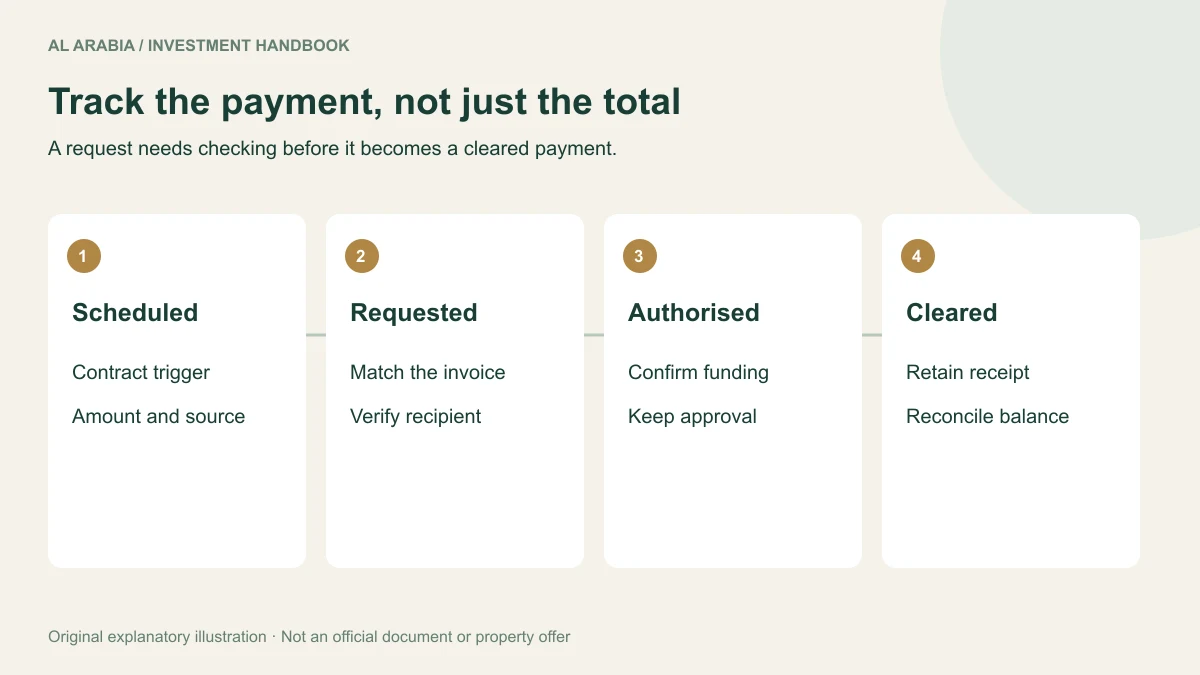
Make one row for each payment event, recording the contractual trigger, amount, intended recipient and evidence required. A fixed date and a construction milestone are different kinds of trigger. Use the language of the reviewed agreement and ask for clarification where it is ambiguous. Track scheduled, requested, approved and cleared as separate statuses. A request received by email is not the same as a payment that has been verified and completed through the bank.
In the fictional example, the remaining SAR 1,140,000 price might be due at a defined completion event under the assumed agreement; the guide does not invent a universal Saudi payment sequence. Copy your actual sequence from the transaction documents. Add the professional-service invoices according to their own agreed terms. Then check whether several payments cluster together. The calendar may reveal a liquidity problem that is invisible when the same commitments are shown only as one overall total.
List the source of funds for each commitment: cleared savings, an approved financing arrangement or another documented source. Distinguish available funds from money expected after a future event. If finance is involved, identify the conditions still outstanding and the provider's process for releasing funds. An indicative borrowing figure does not establish that the provider will fund this property on your preferred date. Confirm how any valuation, document or eligibility condition affects the completion plan.
For international transfers, ask the bank about the evidence it requires, the conversion process and the expected handling time for your transaction. Keep the riyal obligation fixed in the worksheet and record foreign-currency equivalents separately. A website currency converter is a comparison tool, not an executable bank quotation. Include transfer charges and exchange costs only on the basis of the bank's applicable information or a clearly labelled estimate that will be replaced when confirmed.
Create a second schedule for expenses after completion. Include the relevant service charges, utilities, insurance, maintenance, furnishings, management and finance payments. Distinguish one-off setup costs from recurring obligations, and keep the actual bill dates visible. A yearly charge paid immediately after handover can matter more to short-term cash planning than its small monthly average suggests. Ask for evidence of the building's billing arrangements rather than estimating them from another development.
Set your reserve according to your own circumstances and the uncertainties you have identified. This guide does not prescribe a universal reserve percentage. A home for immediate occupation and a rental investment may have different cash needs. For a rental scenario, test a period without income and label any rent assumption as an assumption. Do not use an advertised yield to erase maintenance, vacancy or management costs from the budget. The reserve should remain visible after the purchase has been funded.
Before authorising payment, compare the requested amount with the latest agreement, previous receipts and approved invoices. Independently verify recipient details, particularly if they have changed. Record the verification channel without storing sensitive banking information in a publicly shared file. Investigate differences directly. A contingency allowance is not a reason to accept an unexplained charge, and a familiar sender is not a reason to bypass a payment check.
After funds clear, update the worksheet with the actual amount, date and receipt reference. Keep the final price reconciliation, applicable transaction-charge evidence and ownership reserve together in the property archive. This final version should distinguish what was paid from what remains outstanding. It provides a useful basis for later accounting and ownership planning, while preserving the documents behind the figures. The method stays simple: identify, verify, schedule, pay and reconcile each commitment once.
Official references provide regulatory context. The document, budget and inspection checklists are practical editorial guidance; they are not official forms or individual approvals.
Identify confirmed costs, applicable tax questions and payment dates before committing to a Saudi property purchase.
Read more →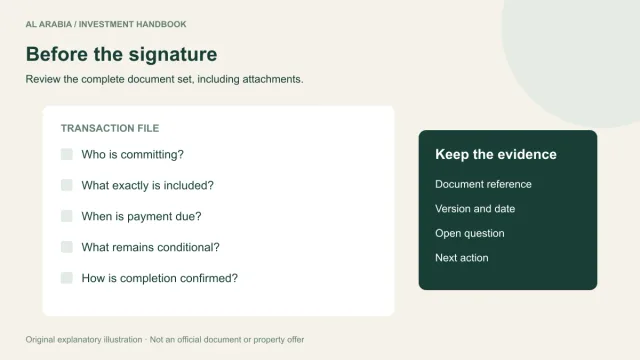
Review the parties, property, price, conditions and completion obligations in your Saudi property agreement.
Read more →
Prepare a room-by-room condition record, access inventory, operating file and follow-up schedule for property handover.
Read more →0 properties selected