Build a Saudi Property Completion Budget and Payment Calendar
Use a clearly labelled fictional example to plan the remaining price, transaction costs, funding and ownership reserve.
Read more →
Identify confirmed costs, applicable tax questions and payment dates before committing to a Saudi property purchase.
An effective purchase budget answers four questions for every amount: what is it for, who pays it, when is it due and what supports the figure? This section helps you turn a Saudi property quotation into a usable completion plan. It separates agreed commitments from estimates and keeps ownership expenses visible after the purchase. The aim is not to produce a universal percentage that works for every buyer. The aim is to identify the figures and obligations that apply to the exact transaction you are considering.
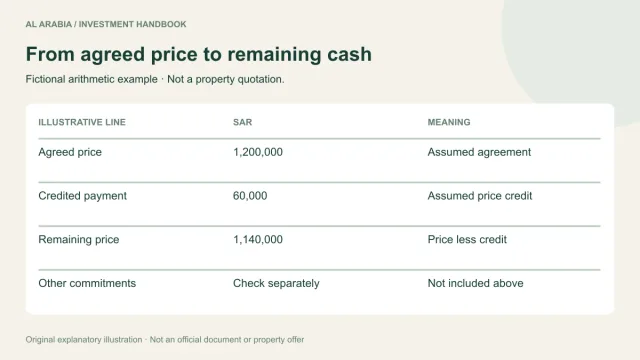
Start with the exact property identifier and the version of the offer being reviewed. Include the purchaser's name or proposed purchasing entity, because changing the buyer may change the documents and advice required. Record the asking price separately from the price actually agreed in writing. Where a payment has already been made, identify its purpose and whether the agreement treats it as part of the price, a separate fee or something else. Never subtract an unexplained payment simply because it reached someone connected with the sale.
Use separate columns for the amount in Saudi riyals, evidence, due date, recipient and status. A confirmed invoice and a verbal estimate should not look identical. Mark unknown costs as unknown instead of entering zero. This small distinction prevents an incomplete worksheet from appearing affordable merely because missing information has disappeared from the total. Assign each unresolved line a person to contact and a date by which the answer is needed.
ZATCA's Real Estate Transaction Tax framework provides a general five per cent rate for taxable real estate transactions, with exemptions governed by the applicable rules. A purchase worksheet must still establish the relevant transaction value, whether an exemption is available and how the payment obligation is handled. A buyer should not infer the final treatment from a marketing description such as investment property, family purchase or first home. Obtain advice where the structure or circumstances require interpretation.
Distinguish the person responsible under the tax rules from any allocation or reimbursement recorded in the sale agreement. Those are related but separate issues. Ask the professional reviewing your agreement to explain the proposed arrangement and check it against current ZATCA guidance. Retain the relevant registration or payment evidence in the completion file. A spreadsheet calculation alone is not proof that a statutory requirement has been satisfied or that an exemption has been accepted.
Ask service providers for an itemised scope and fee before relying on their estimate. Legal review, translation, technical inspection, valuation, brokerage and finance-related services may be separate engagements. The exact services needed depend on the transaction. Confirm what the quoted fee includes, whether taxes are additional, when payment is due and what happens if the purchase does not proceed. Avoid counting the same service twice under two differently named packages.
Treat optional work explicitly. A furniture consultation, design package or letting service should not become an assumed purchase requirement simply because it appears in a combined proposal. If a provider offers several services, identify which parts you have accepted and which remain optional. Keep the signed scope next to the budget line. This helps both sides understand why an invoice is expected and reduces disagreements about work that was discussed but never commissioned.
The sum of all costs is only half the exercise. List the dates or events that trigger payment, such as signing a particular agreement, satisfying a condition or reaching a contractually defined stage. Do not replace an event-based obligation with an invented calendar date. If the trigger is unclear, ask for clarification before signing. The completion-budget article explains how to maintain a separate record for scheduled, requested and actually cleared payments.
For overseas funds, work backwards from the contractual deadline using the bank's information about documentation and processing. Allow for the possibility that a request for additional evidence will need an answer. Do not promise a transfer time on behalf of a bank. Verify recipient details independently, particularly when instructions change. Keep the original riyal obligation visible even if your personal worksheet also displays dollars, euros or another currency for convenience.
Estimate the first year of ownership using evidence where available. Ask for building service-charge information, utility arrangements, insurance requirements, likely maintenance needs and any management proposal you intend to accept. Furnishing and initial repairs should be separate from recurring costs. A property that needs little work at handover can still have annual commitments. Conversely, an initial furniture purchase should not be presented as a recurring monthly charge when comparing two homes.
If the property will be rented, distinguish operating expenses from assumed income. Record the source and limitations of any rental estimate, and test a period without a tenant. If it will be your own home, include the practical costs of moving and temporary arrangements. Neither exercise requires predicting the market. Both help you decide whether the purchase remains manageable when the timing is less convenient than the headline proposal suggests.
Before signing, compare the worksheet with the latest agreement and quotations. Before completion, compare it again with invoices, receipts and the actual remaining balance. Investigate differences instead of smoothing them into a general contingency line. A reserve can help manage uncertainty, but it should not hide an unexplained invoice or a payment sent to an unverified recipient. Keep evidence of which version was approved and who resolved each outstanding question.
After completion, retain a final schedule showing the price, relevant transaction charges, professional costs and first ownership obligations. This becomes a useful reference for accounting, future maintenance planning and eventual resale preparation. Continue into the completion-budget guide for a worked example using fictional amounts. Its purpose is to demonstrate the method; your own figures must come from your agreement, professional advice, providers and current official requirements.
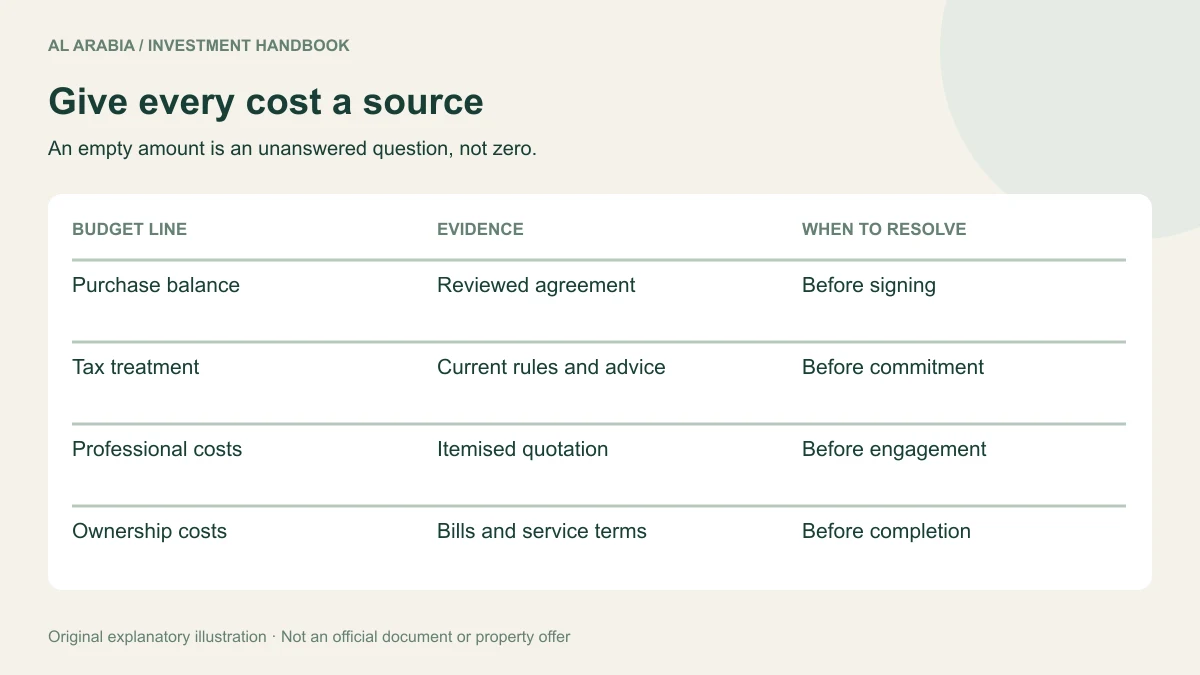
Official references provide regulatory context. The document, budget and inspection checklists are practical editorial guidance; they are not official forms or individual approvals.
Use a clearly labelled fictional example to plan the remaining price, transaction costs, funding and ownership reserve.
Read more →0 properties selected