Saudi Property Purchase Budget & Taxes
Identify confirmed costs, applicable tax questions and payment dates before committing to a Saudi property purchase.
Read more →
Build a practical Saudi property budget covering purchase commitments, finance offers, taxes and ownership costs.
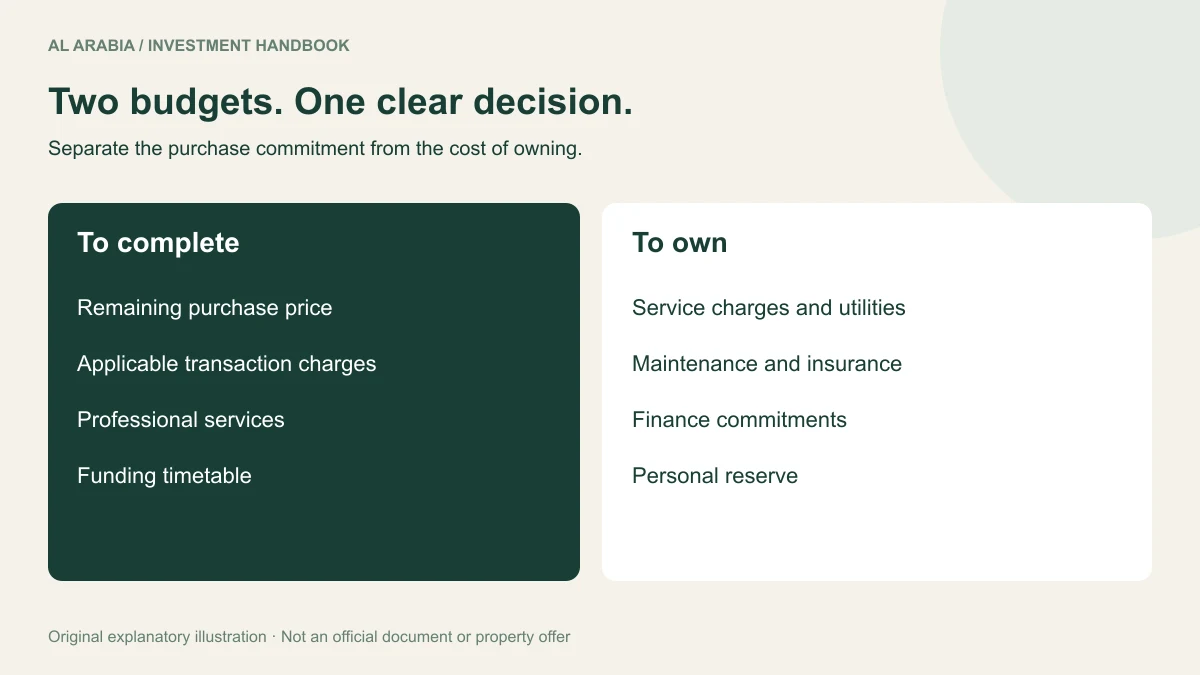
A property budget is a sequence of commitments, not a single asking price. Before comparing homes in Saudi Arabia, separate money needed to complete the purchase from money needed to own and use the property. Then decide which commitments you can meet from available funds and which depend on finance, an asset sale or another event. This section provides a framework for that work. It does not assume that a mortgage will be available to every buyer or that an advertised payment plan is suitable for your circumstances.
Write down the funds that are genuinely available, the currency in which they are held and the date they can be used. Money in an investment that must first be sold is different from cash already cleared in a bank account. Funds arriving from another country may require supporting documents, currency conversion and time for bank checks. Ask your bank about the actual transfer process early, using the proposed transaction documents rather than an approximate description of the purchase.
Keep a personal reserve outside the purchase budget. Its size depends on your own commitments and should not be decided by the maximum price a lender or agent says you can afford. A buyer relocating with a family may need temporary accommodation, school deposits and travel costs alongside the property payment. An investor may need funds for an initial period without rent. Naming these obligations makes a budget more useful than a simple percentage added to the asking price.
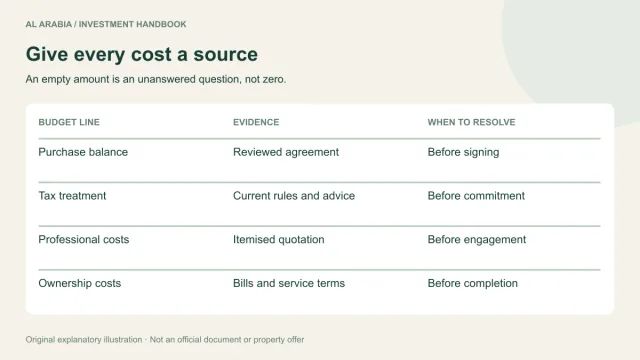
Your completion worksheet should include the agreed price, amounts already paid, the remaining balance, professional services and any transaction charges that apply to your particular case. For every line, record whether it is confirmed, estimated or not yet known. Also identify who is contractually responsible for paying it and who issues the invoice. Do not combine a statutory liability with a commercial agreement about reimbursement: those may be different questions and should be checked separately.
The ownership worksheet starts after completion. It may include building service charges, insurance, utilities, maintenance, furnishing, management and finance payments. Some expenses are monthly, others annual or irregular. Convert them to a common planning period while retaining their actual payment dates. An annual bill due immediately after purchase can create a cash shortage even if the monthly average looks small. Ask for the billing cycle, the latest approved budget and the basis used to allocate shared building expenses.
Saudi Arabia's Real Estate Transaction Tax framework generally applies a five per cent rate to taxable transactions, subject to the law and its exemptions. That headline is not a complete calculation for your purchase. The transaction structure, valuation basis, exemption conditions and parties' obligations need to be checked against current ZATCA guidance. Do not assume an exemption applies because a different buyer received one, or assume that a contract label changes the underlying tax treatment.
Keep a short tax note in the transaction file stating the source consulted, the date and the question that was resolved. If a professional is advising you, ask for the relevant conclusion in writing and identify any assumptions it depends on. This makes later changes easier to detect. For example, changing the purchaser from an individual to a company may require a fresh review rather than a copied calculation. Our budget section is a planning aid, not an individual tax opinion.
If finance is needed, start with a regulated provider and obtain an offer that reflects your circumstances and the specific property. A generic repayment illustration is not an approval. Ask which documents are required, what remains conditional, how long the offer is valid and what can change before funds are released. Nationality, residence, income evidence, property characteristics and the provider's own assessment may matter. Avoid paying a non-refundable amount on the assumption that an online calculator establishes eligibility.
Compare the total commitment, not just the first monthly payment. Review the annual percentage rate where provided, repayment period, fees, insurance or protection requirements, early repayment terms and the treatment of any variable component. Ask the provider to explain unfamiliar terms using a worked example based on the offer. Keep the illustration with the contract version it relates to. If two proposals use different assumptions, align those assumptions before deciding that one is less expensive.
A useful investment worksheet has more than one scenario. Start with the purchase and operating costs you can support with evidence. Then consider slower letting, a period of vacancy, a maintenance expense or a later resale than planned. Label hypothetical figures clearly. A scenario is a way to understand exposure; it is not a forecast that rent, appreciation or occupancy will reach a particular level. Avoid using an advertised gross yield as though it were money available after every cost.
Currency deserves a separate line when your income or savings are not in Saudi riyals. Display conversions can help comparison, but they do not establish the rate or fees your bank will use when a payment is executed. Record the riyal obligation, the expected transfer date and the bank's quotation process. Keep the original riyal figure in every worksheet so that exchange-rate movements cannot accidentally change the contractual amount you are tracking.
Begin with Purchase Budget & Taxes to assemble the cost schedule and identify missing figures. Use the completion-budget article to connect each payment with a date, recipient and supporting document. Then return to the property shortlist: a home that fits the headline price may still create an uncomfortable completion timetable or ownership commitment. Resolve those differences before negotiating terms that assume all funds are ready.
Revisit the worksheet whenever the property, purchaser, payment schedule or finance offer changes. Save dated versions instead of overwriting the evidence behind an earlier decision. Before signing, reconcile the budget with the reviewed agreement; before completion, reconcile it with actual invoices and cleared payments. This disciplined comparison is deliberately simple. Its value comes from keeping financial decisions visible while the rest of the transaction becomes more detailed.
Official references provide regulatory context. The document, budget and inspection checklists are practical editorial guidance; they are not official forms or individual approvals.
Identify confirmed costs, applicable tax questions and payment dates before committing to a Saudi property purchase.
Read more →0 properties selected