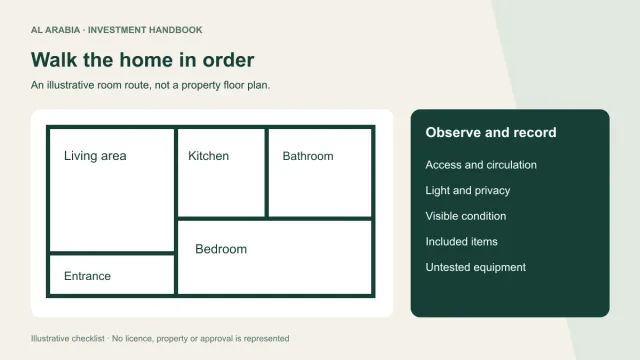
A Saudi Property Viewing Checklist: What to Inspect and Record
Use a room-by-room viewing checklist to record condition, access, shared facilities and unanswered questions before buying a Saudi property.
Read more →
Check a Saudi property advertisement, FAL licence, unit details and payment instructions before making a financial commitment.
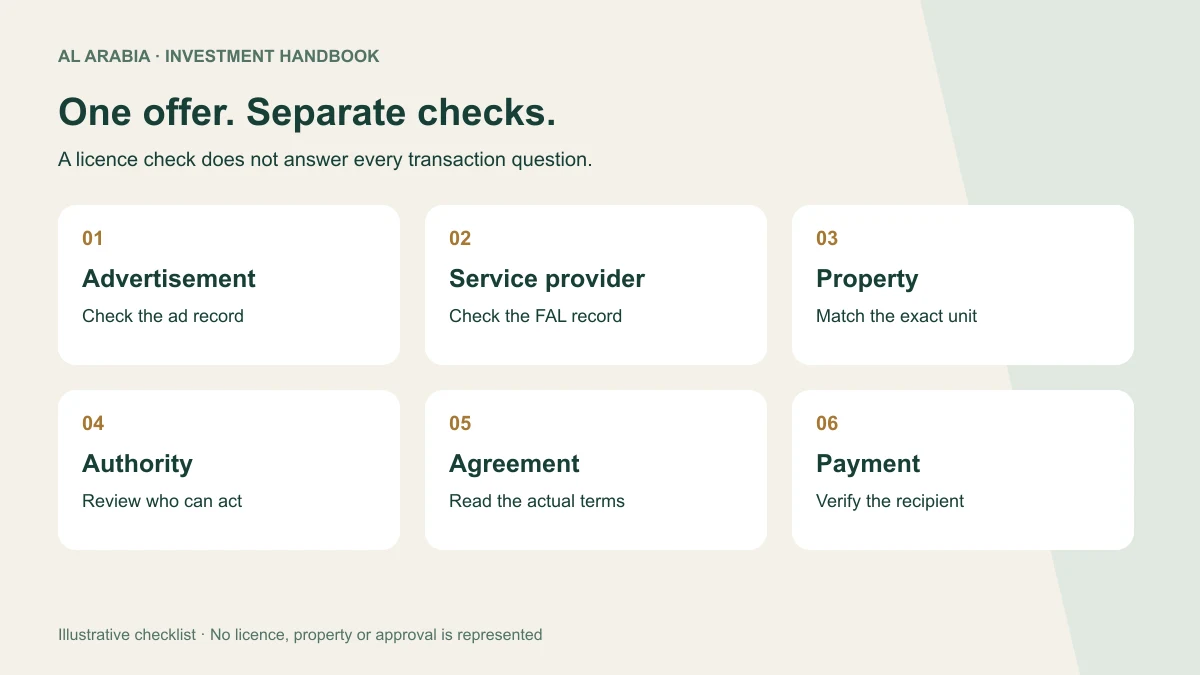
Before you pay a reservation amount or rely on a property advertisement, establish who is offering the property, which asset is being offered and what independent evidence supports the listing. These are separate checks. A professional website, a familiar brand or a photograph of a licence should start an enquiry rather than end it. This guide gives you a practical record-building process for a Saudi property shortlist. It does not certify a particular broker, confirm ownership eligibility or replace a review of the actual transaction documents.
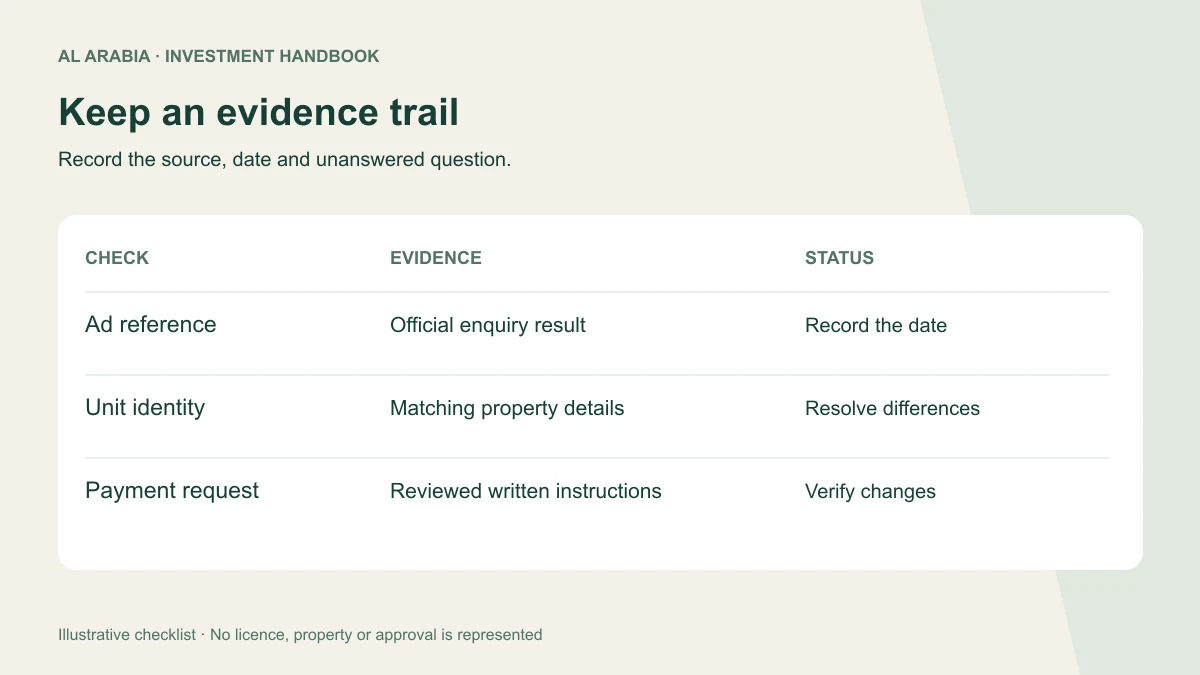
Record the listing address, date, advertised price, location and property reference. Keep the original description and the contact details shown with it. Note whether the photographs depict the actual unit, a show home or an illustration. If the listing is received through a messaging service, ask for the original advertisement and its identification details. A forwarded image can lose context, including when it was published and whether its price or availability has changed.
Create a short property record with separate fields for information supplied and information verified. For example, an advertisement may describe two parking spaces, while your current evidence only confirms one allocated space. Keep both statements visible until the difference is resolved. Do not silently replace the advertisement with the newest verbal explanation. A clear record helps your adviser understand the offer and identify which points need to appear in the contract.
REGA offers an official real estate advertisement licence enquiry. Its service page allows a user to check a licence using the advertisement number. Visit the official service independently, enter the relevant details and examine the result. Keep the date of the check and the information returned. If a service is unavailable or the number does not produce a usable result, record the check as incomplete and ask the advertiser or REGA for clarification.
Avoid treating a QR code or screenshot sent by the contact as sufficient on its own. Check the destination before opening a link and make sure you are using the intended official service. Compare the record available to you with the offer you received. Where the licence status or available information does not fit, pause the related decision. A licence enquiry is one verification step; it is not a valuation, building inspection or approval of the purchase terms.
The FAL licence enquiry concerns the person or establishment providing real estate services. Use REGA's relevant enquiry and the required identifying details to check the provider. Ask the person handling your enquiry to explain their relationship to the establishment and the role they will perform. Record the legal business name, contact channel and identity of the person responsible for the transaction. Similar trading names should not be treated as interchangeable.
This distinction matters when several parties appear in a transaction. The person who introduces a listing may not be the owner, the party signing the purchase agreement or the intended payment recipient. Ask for the chain of roles to be explained. If an additional intermediary becomes involved, update the record instead of assuming the earlier verification covers them. Keep questions factual and allow the relevant party to supply evidence that can be checked through an appropriate channel.
Ask for enough information to identify the precise property: city, district, building or project, unit or plot reference and the proposed right being sold. Compare that information across the advertisement, viewing arrangements and documents supplied for review. A photograph of a similar unit cannot establish the condition or specification of the one you may buy. If the contact proposes a replacement unit, start a separate record so the two offers do not become mixed.
Clarify the area definition, included parking, storage, furniture and appliances. Ask whether a quoted price applies to the identified unit and which exclusions or conditions affect it. Avoid relying on a general brochure where the particular unit differs. Your eventual agreement should identify the asset and included items clearly enough for an adviser to check. Missing information is a question to resolve, not a reason to fill the gap using assumptions from neighbouring listings.
Ask who is legally offering the property and what evidence establishes their authority to act. Have the relevant ownership and representation documents reviewed for the proposed transaction. An advertising enquiry does not replace that review. If a representative will sign, the scope of their authority matters. Keep ownership eligibility for the buyer as a separate workstream, particularly where the buyer is non-Saudi or the proposed acquisition has location-specific conditions.
Before any payment, obtain written instructions identifying the recipient, purpose, amount, timing and conditions. Reconcile them with the agreement being reviewed. Independently verify a material change to bank details using a previously established contact route; do not rely only on the message announcing the change. Never make a small transfer simply to test whether an unexplained account is legitimate. Ask the responsible professional to resolve the discrepancy before authorising payment.
A request to reserve a property should come with terms you can read before accepting it. Ask what is being reserved, for how long, whether the amount is credited towards the price and when it may be refundable. Identify what happens if an important condition remains unmet. Record the person authorised to receive the amount and issue the acknowledgement. Do not assume that the word reservation describes the same commercial arrangement in every transaction.
Give your adviser the actual proposed terms, not a summary of what the salesperson said. Identify deadlines and any documents incorporated by reference. If the explanation and the document differ, request a corrected version or a clear written resolution before proceeding. Keep the version you accepted, payment evidence and subsequent correspondence together. A receipt is useful evidence of a payment, but it cannot answer every question about the underlying agreement.
At the end of the process, prepare a short status note. List the advertisement check, provider check, property identification, authority review and payment instructions separately. Mark each as verified, requiring clarification or not yet reviewed. Include the date and the source of each conclusion. Avoid a single green tick labelled safe: it hides the difference between a completed licence check and a contract or technical issue that remains open.
If a discrepancy remains material, pause the related payment or signature and contact the appropriate official service or qualified adviser. Preserve the original information and your follow-up questions. The useful outcome is not a guarantee that nothing can go wrong; it is a decision based on identifiable evidence and a clear understanding of the remaining work. Once the listing survives these checks, use the property viewing checklist to examine the home itself before progressing to deeper transaction review.
Official references provide regulatory context. The document, budget and inspection checklists are practical editorial guidance; they are not official forms or individual approvals.
Use a room-by-room viewing checklist to record condition, access, shared facilities and unanswered questions before buying a Saudi property.
Read more →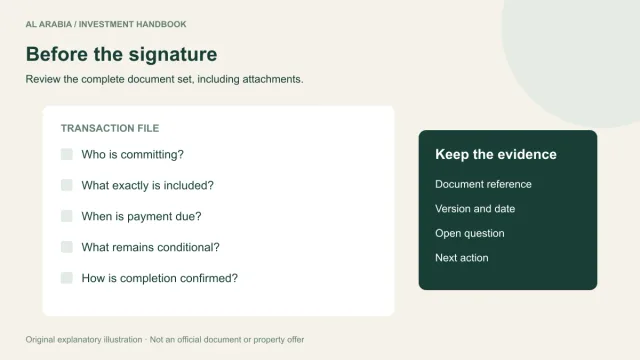
Review the parties, property, price, conditions and completion obligations in your Saudi property agreement.
Read more →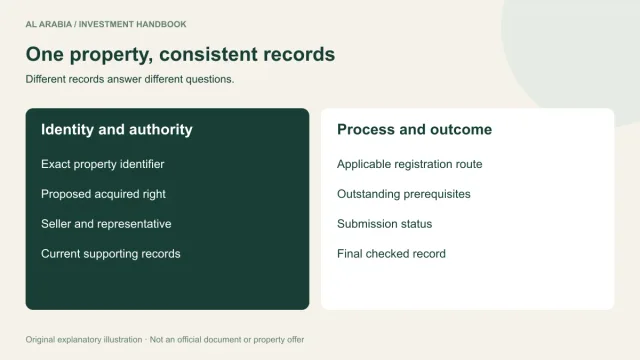
Match the property identity, seller authority and registration evidence before completing a Saudi property purchase.
Read more →0 properties selected