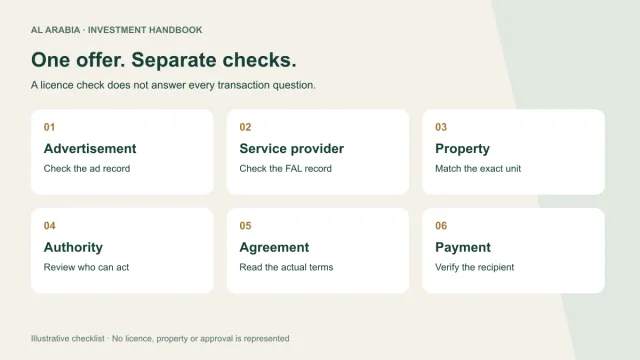
How to Verify a Saudi Property Listing and Broker Before Paying
Check a Saudi property advertisement, FAL licence, unit details and payment instructions before making a financial commitment.
Read more →
Review the parties, property, price, conditions and completion obligations in your Saudi property agreement.
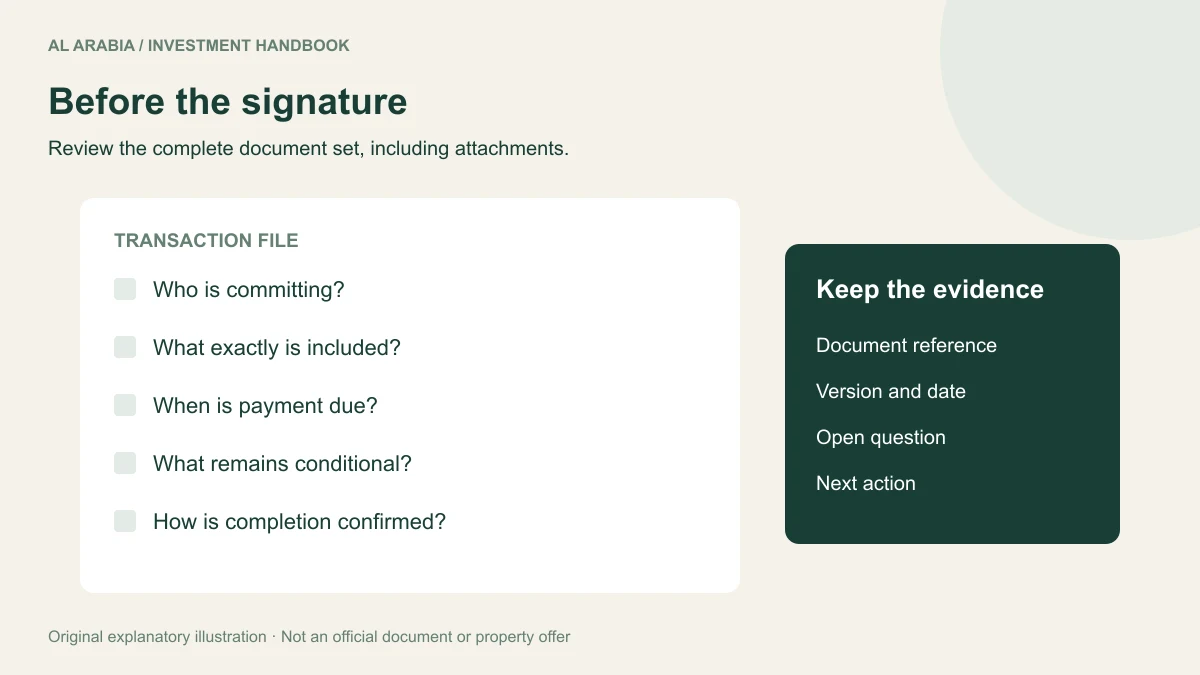
A property agreement should make the proposed transaction understandable before you accept its obligations. The most useful review starts with the actual document, the identified property and your non-negotiable requirements. It does not start with a generic assurance that the contract is standard. This checklist helps an international buyer prepare questions for a qualified adviser reviewing a Saudi property purchase. It is a way to organise the review, not a substitute for legal advice or a statement that every transaction uses the same document or procedure.
Ask whether the document is an expression of interest, reservation arrangement, purchase agreement or an amendment to an existing agreement. Establish what accepting it would commit you to do. The title on the first page may not explain every obligation contained inside. Read the attachments and any referenced terms as part of the proposal. If a document is missing, request it before deciding that you understand the complete arrangement.
Record the version, date and language of the documents supplied. Ask how translations relate to the version intended for signature. If a summary has been prepared for you, compare it with the full document and have material differences explained. A short summary can help navigation, but it should not conceal an exclusion, deadline or condition. Keep your review comments attached to the exact version to which they refer.
Identify the legal buyer, legal seller and any representative signing for either party. Compare names and identifying information across the proposed agreement and the evidence supplied for review. Ask your adviser what authority must be checked for a representative or entity. A sales contact, broker, developer and owner may have different roles. Do not assume that one person's commercial involvement establishes authority to sign every document in the transaction.
Write down who will answer contractual questions and who can approve a change. This helps prevent negotiations with someone unable to bind the relevant party. If another company or individual is introduced, update the parties list and ask why the change is necessary. Keep professional verification separate from a familiar logo or trading name. The agreement needs to describe the actual transaction participants, not only the names used in marketing.
Check the city, district, project, unit or plot identification and the right proposed for acquisition. Review how the area is described and whether any plan or schedule is incorporated. Identify parking, storage, outdoor areas and shared rights where they are material to the purchase. If a number or description differs from the property you viewed, ask for a written reconciliation before assuming it is merely an administrative variation.
Create an included-items list for furniture, appliances, fixtures and agreed work. Link important specifications to the agreement rather than relying on photographs. For a completed home, compare the list with your viewing record. For off-plan property, use a specification schedule and understand the proposed treatment of changes. A phrase such as equivalent finish needs an explanation of how equivalence would be decided and what evidence would be available.
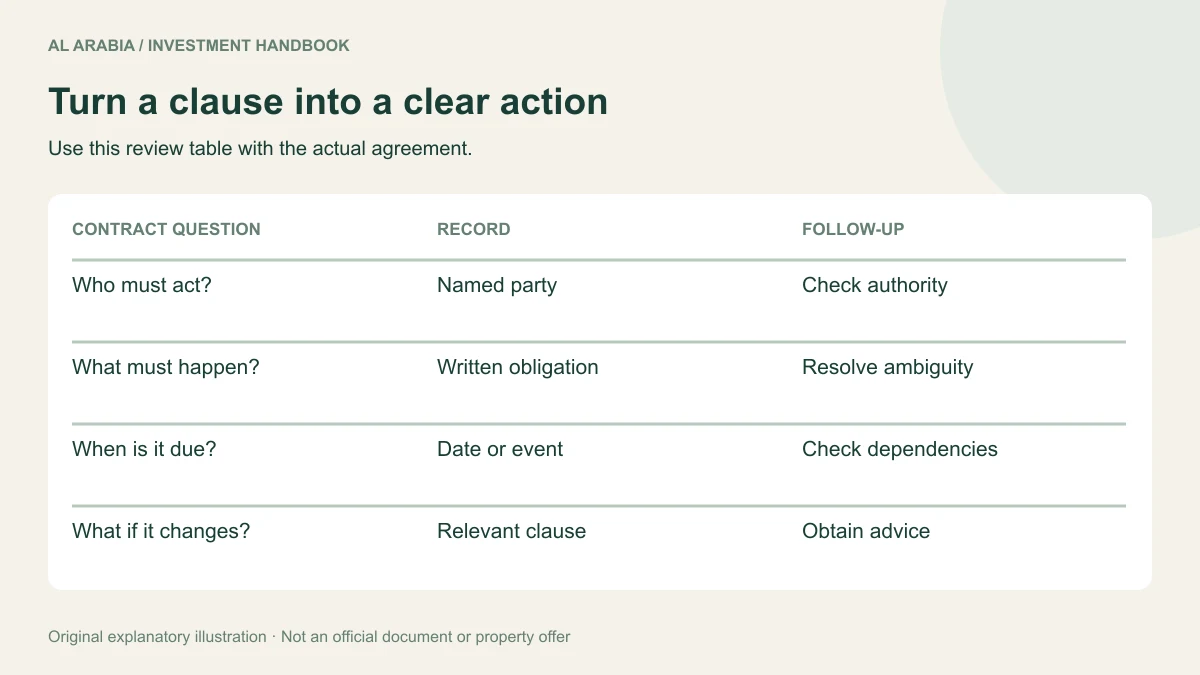
Write the total price and each proposed payment in one table. Record the amount, due event, recipient and document expected at that stage. Check whether a reservation amount is included in the price calculation or sits outside it. Identify separate charges and ask which are confirmed, estimated or still unknown. Do not assume that the cash due at completion equals the advertised price minus the first payment.
Ask your adviser how the contractual payment sequence relates to registration, financing and handover. A payment date may be fixed or linked to a condition; understand which applies. If financing is part of your plan, identify the consequence of an approval delay or refusal before signing. Avoid relying on a salesperson's explanation of what a bank is likely to do. A lending decision and a purchase obligation should be considered separately.
List every important condition that remains unresolved, including ownership eligibility, documents, technical matters or a required consent. Ask how the agreement handles each one. Identify who is responsible for satisfying it, when it must be satisfied and what happens if it is not. For an international buyer, a general ownership-policy headline should not replace a transaction-specific check of the buyer, property, location and proposed right.
Review cancellation, delay, default and refund wording with a qualified adviser. Ask for practical examples based on the actual clauses: what happens if the buyer cannot proceed, if the seller misses an obligation or if the property differs materially from the agreed description? Do not invent an answer from what is common in another country. Record the advice and any negotiated amendment in the final document set.
Identify what the agreement treats as completion and what evidence confirms it. Ask how possession, access, risk, ongoing costs and handover are addressed. These may be connected without occurring at exactly the same moment. Establish which documents and actions must be coordinated, who will manage them and how you will receive confirmation. Collecting keys should not be your only way of deciding that the transaction has reached its intended legal outcome.
Review any acknowledgement you may be asked to sign at handover. Does it describe the property's condition, confirm receipt of documents or address outstanding work? Make sure the statement matches what you can actually verify. If repairs remain, record how they will be tracked and checked. Do not sign a broad statement simply because it is presented as a routine step; ask for its effect to be explained first.
Prepare a final checklist of the agreement, attachments, approved changes and outstanding questions. Confirm that the signing copy matches the reviewed version. Keep a secure copy of what was signed and the evidence of any related payment. Record who holds originals where that matters and how additional copies can be obtained. Share sensitive documents only through a channel appropriate to the recipient and purpose.
Your signing decision should be based on resolved material questions, not the length of time already spent negotiating. If a late amendment changes an important term, give the relevant adviser an opportunity to review it. The objective is a document set that explains the deal accurately and remains useful after completion. Continue with the registration-records guide to connect those contractual promises to the evidence needed for the next transaction stage.
Official references provide regulatory context. The document, budget and inspection checklists are practical editorial guidance; they are not official forms or individual approvals.
Check a Saudi property advertisement, FAL licence, unit details and payment instructions before making a financial commitment.
Read more →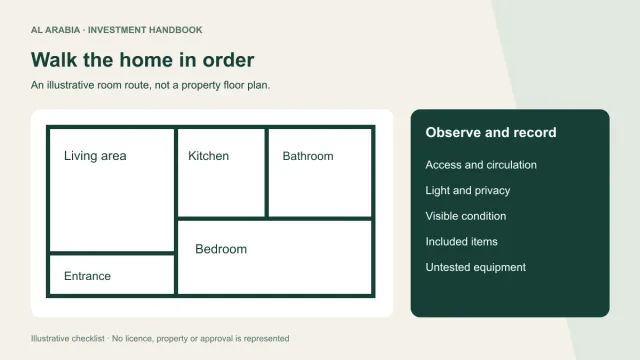
Use a room-by-room viewing checklist to record condition, access, shared facilities and unanswered questions before buying a Saudi property.
Read more →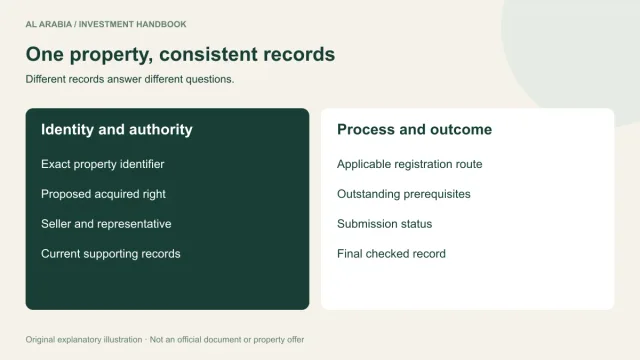
Match the property identity, seller authority and registration evidence before completing a Saudi property purchase.
Read more →0 properties selected