
Build a Traceable Property Evidence File
Organize a Saudi property purchase evidence file with source dates, document versions, open questions and payment records that remain easy to trace.
Make each conclusion traceable
A property evidence file should show where each important conclusion came from and whether the supporting record is still current. It is more than a folder of identification documents. For a Saudi property purchase, a useful file connects the asset, its documents, your unanswered questions and your decision history without treating a document's existence as proof that its contents are correct.
This is an original organizational method, not an official document checklist or a substitute for legal advice. Required records depend on the asset, transaction and parties. The purpose is to help you and your advisers identify what was checked, what changed and what must be resolved before the next commitment. Use current professional and official guidance for the requirements of your own transaction.
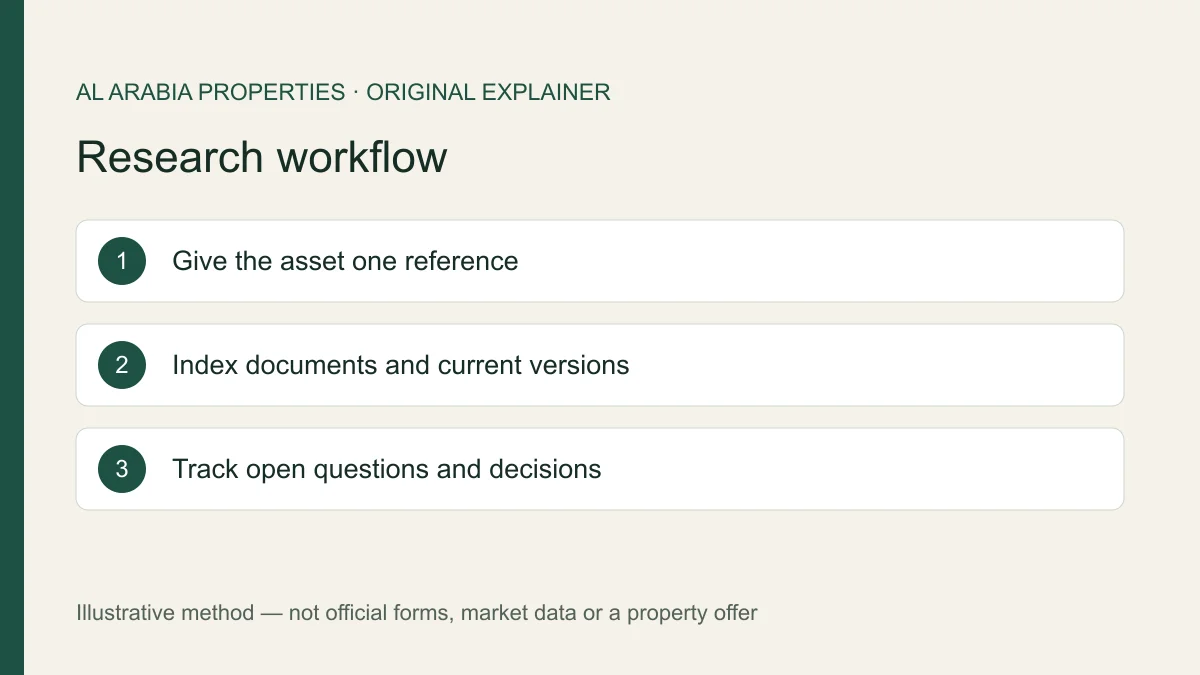
Start by giving the proposed asset one internal reference. Record its supplied address, seller or developer identity and any official identifiers available for verification. Keep unverified details clearly labelled. If two documents appear to describe different units, do not merge them merely because the marketing names sound similar.
Create an index before adding documents
Build a simple index with one row per record. Useful columns include the document name, issuing or supplying party, issue date, date received, version, related asset identifier, verification status and responsible reviewer. Add a column for the specific decision it supports. This makes it easier to see that a floor plan supports a layout discussion while a payment schedule supports a cash commitment.
Store the original file separately from your notes. A filename such as asset-reference_document-type_issue-date_version can help, but your index remains the main source of meaning. Do not depend on a name alone: downloaded files can have inaccurate labels, and a document may be superseded without its title changing.
Restrict access according to the contents. Identification, financial records and personal correspondence should not be published on the website or placed in public development folders. The evidence file discussed here is a private buyer workflow. Shared adviser access should be deliberate, limited to what is needed and managed through appropriately protected storage.
Link evidence to the claim it actually supports
For each claim, write the narrow question being answered. A licence inquiry, for example, addresses a specific licence record; it does not replace a title review or an inspection. REGA provides an advertisement licence inquiry service using the licence number to check validity. Keep the query date and result with the relevant advertisement, rather than describing the check as approval of the entire purchase.
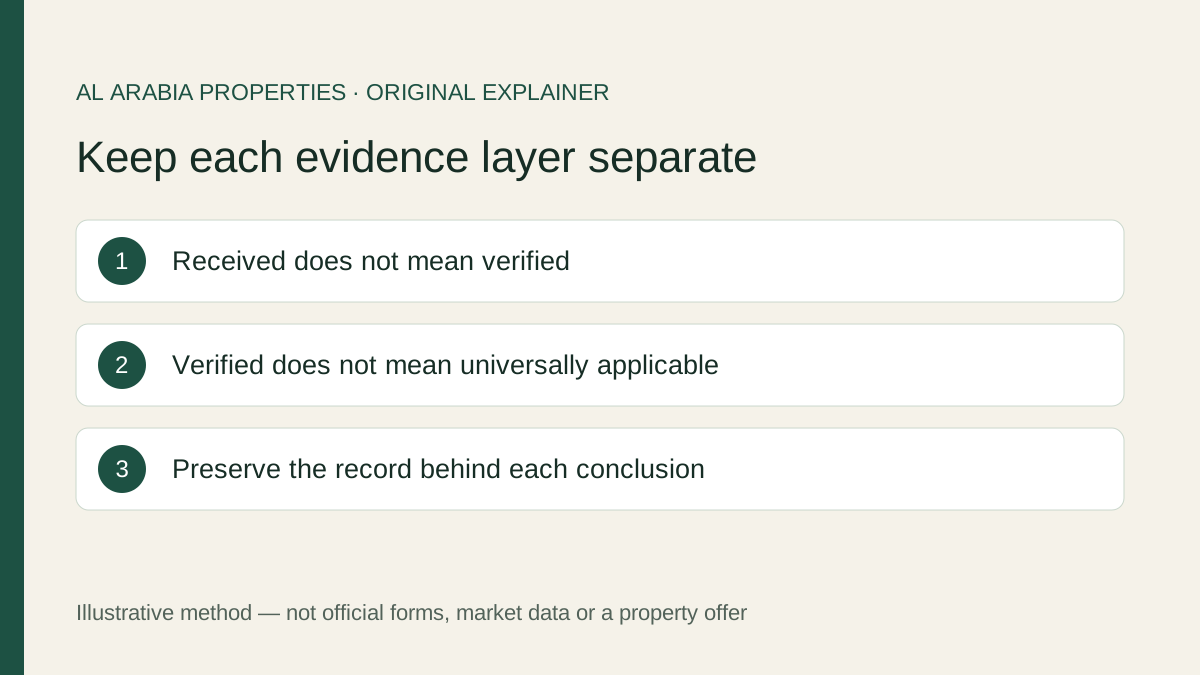
Classify statements as verified, supplied but unchecked, disputed or awaiting evidence. These labels are more informative than a single completed checkbox. A document can be received while its identity, scope or applicability remains unresolved. Conversely, a clarification may answer one question while leaving the rest of the transaction unchanged.
Use the listing and broker verification guide for the separate checking process. Your evidence index should record its results and limitations. Avoid copying a green status from one task to another when the questions and supporting records differ.
Preserve versions and explain changes
When a revised document arrives, retain the previous version and mark which version is current. Record what changed and who clarified the effect. A new payment schedule, specification or contract draft can alter your budget or obligations even when the headline price is unchanged. An unexplained replacement should become an open question, not a silent overwrite.
Keep comparisons specific. Instead of writing that the contract was updated, note that the supplied draft changed a stated payment date or replaced a listed specification, if that is what the documents actually show. Ask the relevant adviser to explain the effect before you rely on your own interpretation. Store the response beside the version comparison.
The purchase contract checklist helps frame questions for review. A traceable file complements that checklist by preserving the document and answer used at the time. It cannot decide whether a clause is enforceable or appropriate for your circumstances.
Use an open-question register
Maintain a separate list of unresolved questions with an owner, date raised, evidence needed and next action. Link each question to the relevant document. Examples include a mismatch in unit identity, an unconfirmed service charge or a payment instruction that differs from the reviewed agreement. These examples are research prompts, not claims that a particular seller has a problem.
Set a practical decision consequence for each question. A spelling issue may need correction; an uncertainty about the asset or payment recipient can affect whether you proceed. Obtain advice appropriate to the issue. Do not close a consequential question merely because someone responded quickly or because a deadline makes waiting inconvenient.
When a question is answered, record the answer and the evidence supporting it. Preserve contradictory information for your adviser rather than removing it to create a cleaner file. A tidy collection of documents is useful only if it accurately represents what you know and what remains uncertain.
Connect the file to money and inspection
Keep a payment register that distinguishes scheduled, requested, authorized and confirmed amounts. Reference the supporting agreement and payment evidence for each entry. Protect sensitive account information and confirm instructions through the appropriate secure process. A screenshot of a request is different from evidence that a payment has cleared or that the recipient is correct.
Pair this register with the completion budget. The budget estimates what you may need; the register records the status of actual commitments and payments. Explain any difference between them before concluding that all funds are accounted for.
Attach inspection and handover records to the same asset reference. Keep observed issues, agreed actions and completion evidence distinguishable. The handover checklist provides practical questions; your file should preserve who recorded an issue, what was agreed and how resolution was evidenced.
Review the file at each decision point
Before committing, review the index, current versions and open questions with the relevant advisers. After a change, update only the affected conclusions and explain why. Following completion, retain the final reviewed records and the history needed to understand them, using an appropriate retention and security arrangement for your circumstances.
A good file does not need to be elaborate. It needs a consistent reference, clear sources, honest statuses and a visible chain from evidence to decision. If another authorized reviewer can understand why you relied on a record, and identify which questions still require work, the organizational method is doing its job. The final benefit is clearer collaboration and fewer assumptions hidden inside a pile of attachments.
Sources and scope
- REGA advertisement licence verification — checked 2026-09-29. Licence inquiry verifies advertisement licence validity using its number; no wider guarantee implied.