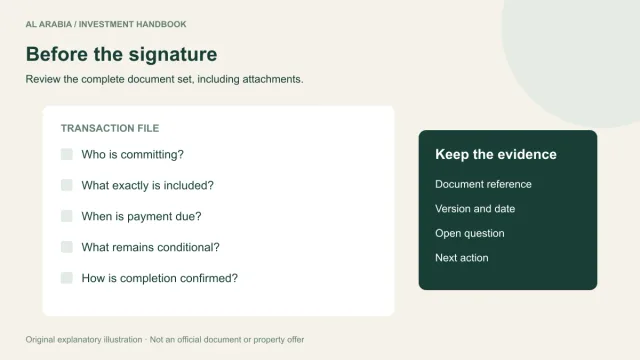
Before You Sign: A Saudi Property Purchase Contract Checklist
Review the parties, property, price, conditions and completion obligations in your Saudi property agreement.
Read more →
Prepare your purchase agreement and registration file with clear responsibilities, document checks and completion evidence.
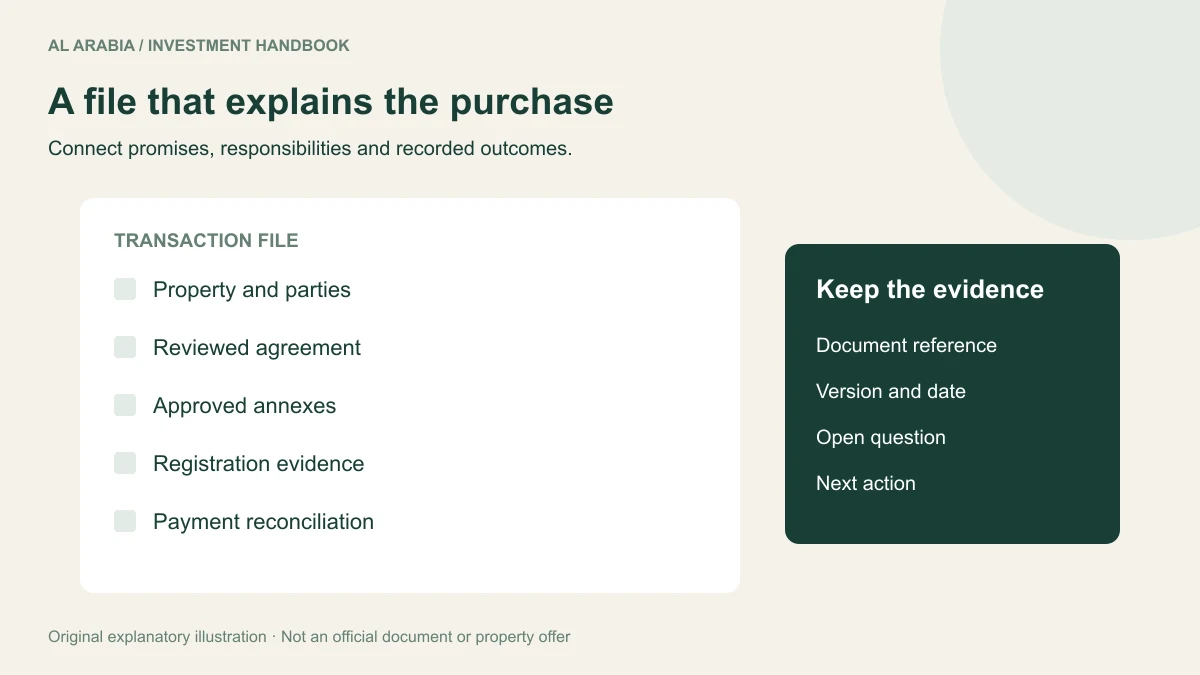
The contract and registration stage turns a selected property into a defined transaction. A buyer needs to understand the proposed agreement, the evidence behind the seller's position and the process that will establish the acquired right. These tasks overlap, but they are not interchangeable. A signed reservation form does not answer every title question, and a property record does not explain every promise in a sales agreement. This topic helps you organise the documents and professional questions before a payment deadline makes the process feel urgent.
Start with an index rather than a pile of attachments. Record the latest version of the reservation document, purchase agreement, property identification, included-items schedule, payment plan and relevant ownership evidence. For each item, note who supplied it, when it was received and whether it is complete. Keep superseded versions in a separate archive. A reviewer should be able to identify the current proposal without comparing several attachments that all have the same filename.
Use the same property reference throughout the file. Where a building, plot or unit has more than one identifying number, ask the responsible party to explain the relationship. Record the buyer and seller names consistently, including any entity or authorised representative. Differences between a trading name, an individual's name and the party shown in an agreement should be resolved explicitly. They should not disappear behind an assumption that everybody involved represents the same organisation.
For each significant clause, ask who must do what, by when and with what evidence. Start with the asset and right being acquired, then review the price, included items, payment milestones, completion conditions and handover arrangements. A useful review is specific enough to describe what happens if a promised document does not arrive or an agreed feature is absent. General reassurance is less useful than a clear explanation tied to the relevant wording.
Create a promises schedule alongside the contract review. List material statements made during the sale, such as furniture inclusion, a parking allocation or work to be completed. Identify where each statement appears in the agreement or an incorporated attachment. If it appears nowhere, ask whether it is actually part of the proposed deal. Do not assume that a brochure, conversation or illustration carries the same effect as a negotiated contractual obligation.
Give your adviser the complete documents and a summary of your objectives. Explain which matters would cause you to withdraw, require a change or seek more evidence. Ask what the review covers and what requires another specialist. A lawyer may need a technical report to assess a condition clause, while an inspector cannot decide the legal effect of a cancellation provision. Agree who will coordinate questions crossing more than one discipline.
Allow time for revisions and a final comparison. If the seller sends a revised agreement, check which changes were made and whether any other wording changed with them. Keep a dated record of the version approved for signature. Ask how signatures, representation and any translation needs will be handled for the actual parties. Avoid treating a translation as authoritative without understanding how it relates to the document you will sign.
REGA describes real estate registration as a system that records the property and associated ownership information, rights and restrictions. The practical buyer task is to establish which process applies to the identified property and which current records should be reviewed. Ask your adviser to distinguish an initial registration from a later transfer or other transaction. A generic online checklist may not describe the service applicable to your property and buyer profile.
Prepare a registration responsibilities sheet. Identify who will supply the records, correct discrepancies, submit any application and confirm the final result. Ask what evidence will be available to you after completion. If an intermediary reports that something has been submitted, distinguish that from approval or completion. Retain the application reference and the final record separately. A status message should not be the only evidence kept in the purchase file.
List each proposed payment with its purpose, recipient, due date and supporting condition. Match the list to the agreement and any financing arrangement. Identify which documents need to be reviewed before the payment can sensibly be authorised. This is a planning exercise, not a recommendation to withhold money contrary to an agreement: resolve the sequence with your adviser before accepting the terms. Later disagreements are harder to manage when the sequence was never understood.
Use a verified route for payment instructions and independently confirm material changes. Keep the instruction, approval and payment evidence together. If an account, recipient or amount differs from what was reviewed, ask the responsible professional to reconcile it. Do not allow a short deadline to turn an unexplained change into an accepted fact. An organised completion file should make it possible to explain every outgoing amount and the obligation it satisfied.
After the transaction, store the final signed agreement, incorporated schedules, payment evidence and ownership records in a secure archive. Keep an accessible index without exposing sensitive information unnecessarily. Record how to contact the relevant professionals if a later query arises. Your future property manager, lender or resale adviser may need selected documents, but they do not automatically need the entire confidential file.
The articles in this topic provide a contract-question checklist and a registration preparation guide. Use them to identify gaps, then obtain advice tied to the actual transaction. The aim is a purchase file that explains the property, the parties, the obligations and the completed steps. It should remain useful after the excitement of collecting keys, when reliable records become more valuable than remembered conversations.
Official references provide regulatory context. The document, budget and inspection checklists are practical editorial guidance; they are not official forms or individual approvals.
Review the parties, property, price, conditions and completion obligations in your Saudi property agreement.
Read more →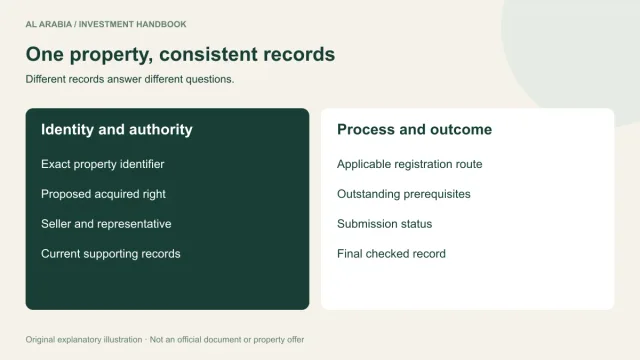
Match the property identity, seller authority and registration evidence before completing a Saudi property purchase.
Read more →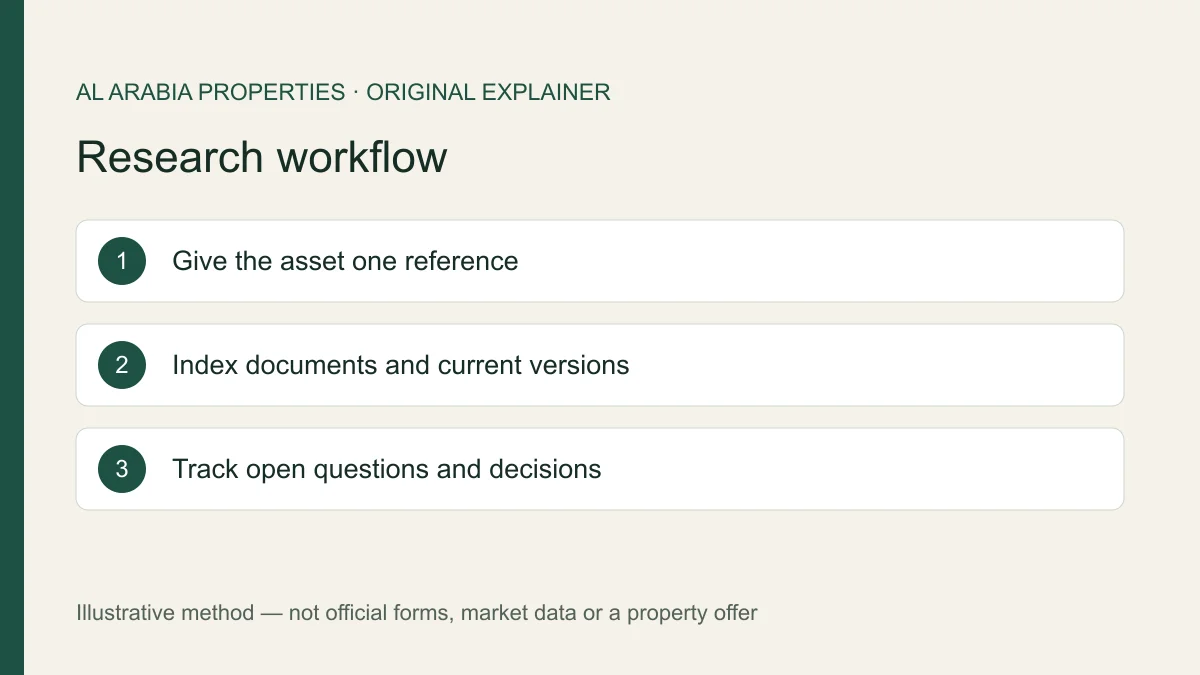
Organize a Saudi property purchase evidence file with source dates, document versions, open questions and payment records that remain easy to trace.
Read more →0 properties selected