Property Search & Inspections in Saudi Arabia
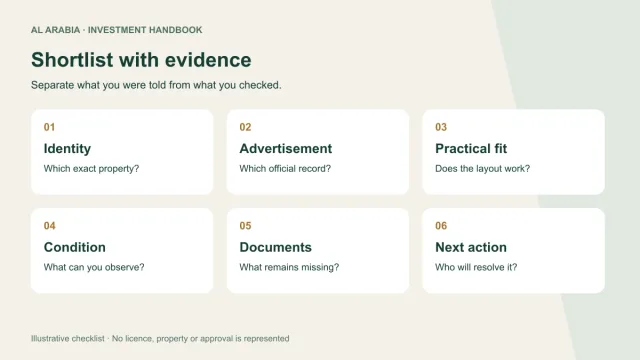
Build an evidence-based shortlist, verify listing information and prepare a practical property viewing checklist in Saudi Arabia.
Read more →
Plan your Saudi property purchase, from the first shortlist and inspection to contract review, completion and handover.
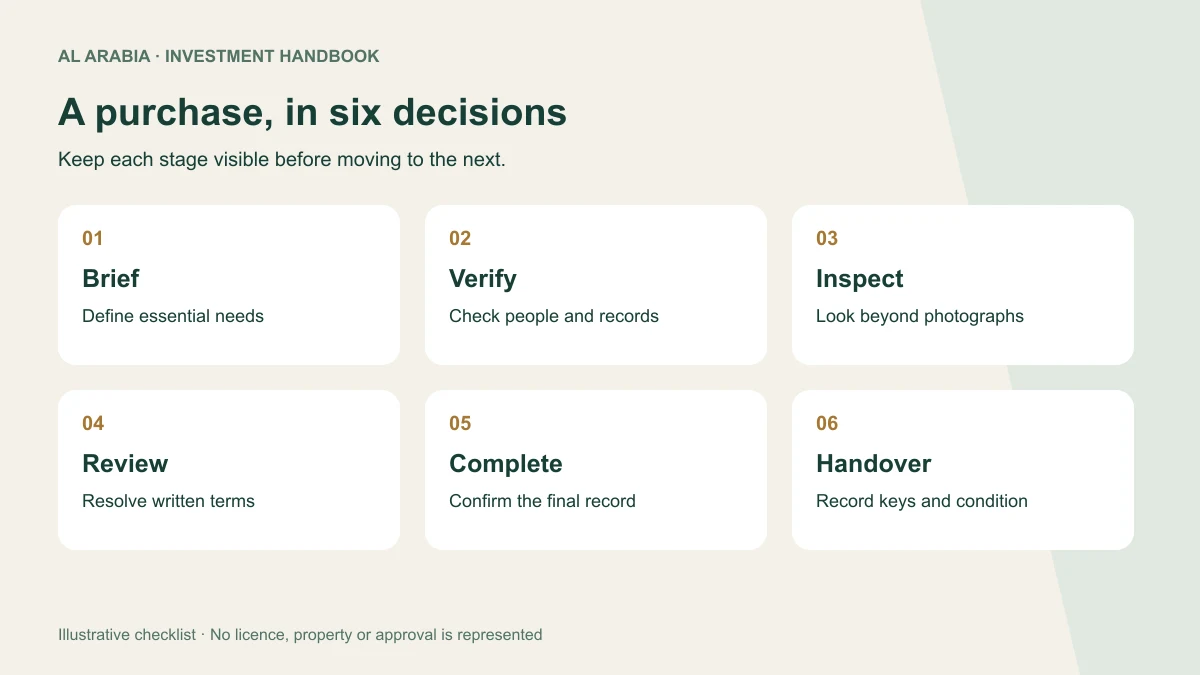
Buying property in Saudi Arabia involves several connected decisions: choosing a suitable home, checking the people and documents behind the sale, understanding the agreement, arranging payment and confirming completion. A polished advertisement answers only a small part of that journey. This section of the Investment Handbook helps you organise the work between an initial shortlist and a purchase you can explain, document and manage. Start with the stage you have reached, then use the related checklists to identify what still needs an answer.
Write down why you are buying before deciding which property to view. A home for your family, a future relocation base and an income-producing investment need different comparisons. Record your preferred location, property type, approximate budget, intended holding period and practical requirements. Include parking, accessibility, outdoor space, workspace and the number of rooms you actually need. Divide these into essential features and preferences. A property with an attractive finish may still be unsuitable if it fails a requirement that cannot be changed after completion.
Keep the brief short enough to use during a viewing. Five essential requirements are more useful than a long wish list that makes every property appear equally suitable. Add a decision date, but avoid turning it into a reason to accept an unresolved problem. If your preferred area, budget and essential features do not fit together, change the brief deliberately and record why. That creates a consistent basis for comparing the next group of properties.
An international buyer should establish the relevant ownership route alongside the property search. A listing does not confirm that its location, proposed right or transaction is available to that buyer. Use the separate Foreign Property Ownership section to prepare the buyer and property facts needed for an official enquiry. Then bring the resulting conditions back into the purchase brief. This prevents a good physical fit from being mistaken for a complete legal fit.
The same separation applies to financing. An indicative budget is not a binding lending decision, and a salesperson's payment illustration is not a finance offer. Record how the purchase would be funded and which approvals remain outstanding. Ask how the contract deals with an unmet condition before paying an amount that may be difficult to recover. The purpose of the handbook is to make those questions visible early, while you still have room to choose another option.
For each candidate, collect the original advertisement, location, unit reference, asking price, stated area and construction status. Note when each item was supplied. Ask whether a figure describes the private unit, a saleable area definition or something else, rather than comparing numbers that may measure different things. Confirm what the asking price includes. Furniture, parking, storage and appliances should not remain assumptions based on photographs or a show home.
Use the Property Search & Inspections guides to verify the advertising and brokerage information and plan the viewing. Treat the checks as separate tasks: identifying a licensed service provider, checking the advertisement, confirming the precise asset and examining its condition. Passing one check does not automatically answer the others. Keep an unresolved column in your shortlist so that missing evidence remains visible beside the features you like.
A viewing should cover how the property works, not just how it looks. Check circulation, daylight, privacy, storage, parking access and the relationship between rooms. Observe visible condition issues without trying to diagnose hidden defects yourself. Ask permission before operating equipment or taking photographs. If utilities are disconnected or a room cannot be accessed, write that down as a limitation rather than treating the item as satisfactory.
Walk the shared areas and the route from the entrance to the unit. Consider lifts, stairs, refuse arrangements and access for deliveries. Visit the surrounding area at a time relevant to your intended use, when practical. A short visit cannot establish year-round traffic, noise or cooling performance. Important uncertainties should lead to another observation, a document request or an independent specialist inspection before you commit.
Once a property survives the initial checks, collect the proposed reservation terms and purchase documents. Identify the parties, asset, price, included items, payment milestones and conditions for completion. Make a list of sales promises and locate each one in the written documents. If a material feature is missing or described differently, ask for the discrepancy to be resolved before signature. Keep a version record so everyone reviews the same agreement.
Use appropriately qualified advisers for the actual legal, tax and technical questions. Ask for a defined scope: which documents will be reviewed, what cannot be verified and which issues require further work. A general conversation does not replace a review of the particular property and contract. Ensure you understand the practical consequence of cancellation, delay, a financing problem or an ownership condition that has not been satisfied.
Before completion, create a responsibilities list for final documents, payments, registration, possession and handover. Give each item a named responsible party and a way to confirm it is complete. Keep payment instructions separate from informal messages, and independently verify a material change. Ask which ownership record will be available after the process and how you will obtain and retain it. Do not equate collecting keys with completing every transaction requirement.
Finally, plan the work that follows possession: meter readings, access credentials, warranties, maintenance contacts, insurance enquiries and any agreed defect follow-up. Retain a dated handover record and photographs taken with permission. The best purchase file is useful after the transaction as well as during it. It should help you operate the property, answer an adviser or prepare for a future sale without reconstructing basic facts from scattered conversations.
Official references provide regulatory context. The document, budget and inspection checklists are practical editorial guidance; they are not official forms or individual approvals.
Build an evidence-based shortlist, verify listing information and prepare a practical property viewing checklist in Saudi Arabia.
Read more →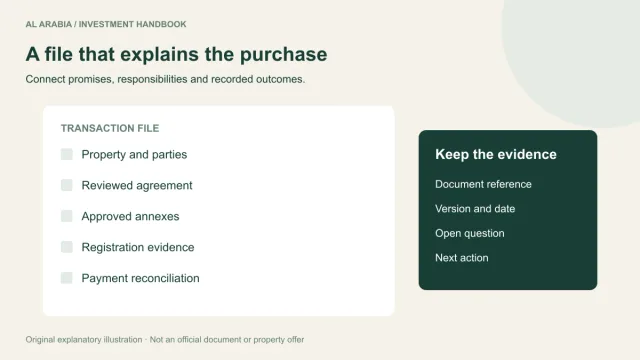
Prepare your purchase agreement and registration file with clear responsibilities, document checks and completion evidence.
Read more →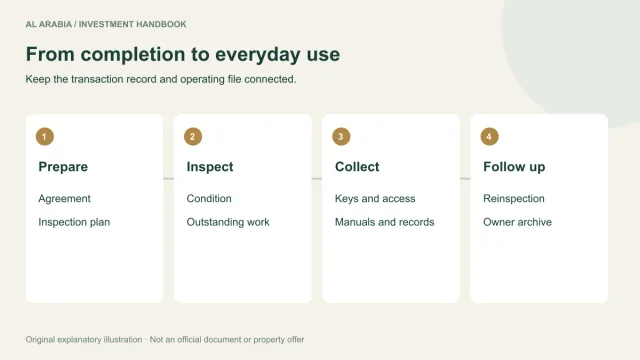
Organise the final payment sequence, property inspection, keys, operating documents and outstanding work.
Read more →
Identify smoke-warning equipment, match its manual, coordinate checks and track records before choosing or taking handover of a Saudi home.
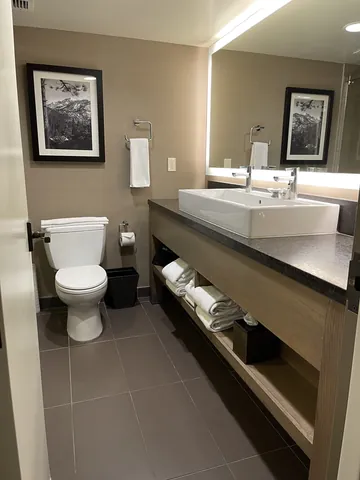
Review bathroom fixtures, permitted normal operation, drainage, ventilation, room fit and the evidence to request before buying a Saudi home.
0 properties selected