
Saudi 2027 Pre-Budget Statement: Property Context
Read the dated FY2027 fiscal projections, distinguish national spending from local property evidence, and build a traceable research note.


Saudi Arabia’s Ministry of Finance published its pre-budget statement for financial year 2027 on 30 September 2026. The announcement provides a current national fiscal outlook that property readers can use as background for scenario planning. It does not establish a neighborhood’s rental growth, a building’s value, or a particular infrastructure project’s delivery date. The practical task is to keep national projections separate from the local evidence needed for a property decision.
This article reports the dated announcement first, then offers original analysis of how to read it alongside property information. Sources were reviewed on 4 October 2026. All suggested questions and illustrative decision methods below are editorial analysis, rather than Ministry forecasts or personal investment recommendations.
What was announced on 30 September
The Ministry of Finance announcement gives preliminary 2027 revenue of SAR 1,202 billion and expenditure of SAR 1,392 billion, with an expected deficit of 3.6% of GDP. These are national fiscal projections for a future financial year. They are not amounts spent in a particular Saudi city, and the revenue figure describes government revenue rather than real estate sales.
The accompanying FY2027 pre-budget statement, particularly its medium-term fiscal table on printed page 21, labels the 2027 figures as projections. Its table reports a budget balance of negative SAR 191 billion. Subtracting the displayed rounded revenue and expenditure totals produces SAR 190 billion; that arithmetic should not replace the source’s reported balance. Rounded headline totals do not necessarily reconstruct a separately rounded component exactly.
The distinction matters when reproducing a number in a research note. Keep the unit, financial year, projection label and source together. A reader should be able to identify what the figure measures without following a chain of assumptions about construction spending or household incomes.
A pre-budget statement is a planning reference
A document issued before the relevant financial year can help establish a starting position for monitoring later announcements. Its usefulness comes partly from its timing: an analyst can save the September outlook and compare it with subsequent official documents. That comparison is meaningful only when the same measure and financial year are being compared. Replacing a revenue projection with an expenditure estimate would create an apparent change that does not describe the same thing.
For a property research folder, record the document title, publication date, financial year and page containing the selected figure. Keep a short note describing why the measure is relevant to the research question. If the question is local employment demand, aggregate government expenditure is background; it is not a substitute for evidence about employers operating near the property.
Use the statement as a reference point rather than a complete property outlook. A forecast can be informative while leaving a large amount unresolved. That is a reason to make assumptions visible in a model and monitor them, not a reason to fill those gaps with confident predictions.

Separate the national scale from the property scale
A Saudi fiscal projection covers a national government account. A lease covers a specific space, tenant, payment schedule and contractual period. Between those two scales sit many questions: where activity takes place, who uses the space, what competing supply exists, and how much of any change reaches the owner’s collected income. None of these intermediate steps can be skipped simply because the national number is large.
Start with the smallest decision-relevant unit. For an apartment comparison, that could mean the specific building and the nearby homes a prospective tenant would reasonably consider. For an office, the relevant comparison might involve premises serving the same type of occupier. A broad city label alone can hide substantial differences in access, building condition and usable space.
Our guide to asking and achieved Saudi property prices explains another scale problem: an advertised price and a completed transaction answer different questions. A fiscal headline is farther removed still. Keep each type of evidence in its own role before combining them in an argument.
Build a claim chain before changing a forecast
A useful research exercise is to write the proposed connection as a sequence. For example: a specific activity expands in a defined place; identifiable occupiers require additional space; suitable competing space is limited; negotiated rents change; and the owner collects additional cash after vacancies and expenses. Each step asks for different evidence. The national statement may supply context for the first step without proving any of the later ones.
Then identify the weakest link. A forecast based on nearby employment growth is incomplete if the relevant staff are already housed elsewhere or if the property does not match their requirements. A forecast based on new transport access is incomplete if the usable entrance, service pattern and actual walk are unknown. These are questions to investigate rather than reasons to invent occupancy figures.
Keep the conclusion proportional to the evidence. A defensible note might say that a dated announcement justifies monitoring an area more closely. It should not jump directly to an expected return. A good claim chain lets a reader see which assumptions would need to change before the conclusion could change.


Do not assign aggregate spending to a photographed project
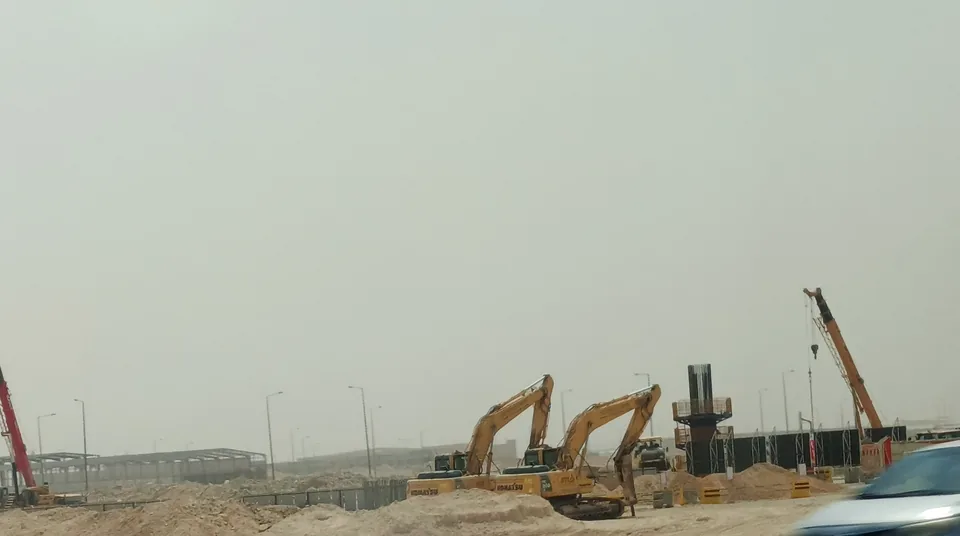
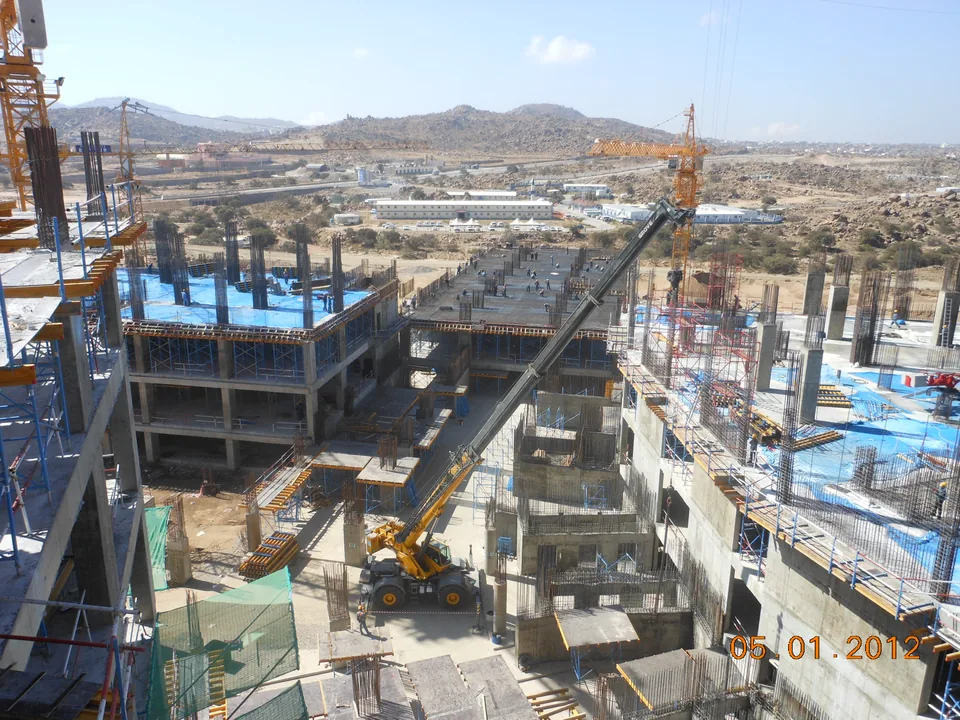
Construction photographs can make an economic story easier to visualize, but they cannot establish a fiscal allocation. A crane, a partly completed structure and visible site activity do not reveal who paid for the work, the remaining budget, the intended occupants or the date when usable space will be delivered. The photographs accompanying this article are expressly contextual historical images.
When a property argument depends on a particular project, establish its identity from an appropriate current primary source. Distinguish an announcement from an awarded contract, construction progress, operational opening and demonstrated usage. These milestones can describe different stages, and a document addressing one should not be presented as proof of all the others.
The same discipline applies to location. An image taken in Riyadh does not show the situation in every Riyadh district. A photograph of one educational construction site cannot stand for all government capital expenditure. Captions should identify the actual scene and the limited reason for including it, leaving financial attribution to evidence that can support it.
Translate uncertainty into explicit property scenarios
Once the national context is understood, a property model still needs its own inputs. Keep a base case built from identified property evidence, then create alternative cases by changing specified assumptions. For example, examine delayed occupancy, a lower collected rent or an additional repair requirement separately. Changing several assumptions at once may produce a useful stress, but label the combined changes so that the result remains understandable.
Avoid presenting a downside scenario as a forecast from the Ministry. It is an analyst’s test of a property model. Equally, avoid describing the base case as guaranteed because it uses conservative language. A modest assumption can still be unsupported, and a well-explained stress can still omit an important cost.
The rental yield calculation guide helps keep property income and price in a consistent calculation. Start there if a news headline has prompted a return estimate. Establish what is actually being collected and what the denominator includes before deciding whether the economic context changes the model.
Financing questions need their own evidence
A projected national budget deficit is not a borrower’s repayment schedule. It does not establish a particular lender’s pricing, approval criteria, financing availability or treatment of a property. If financing affects the proposed investment, use the actual written facility information and identify the payment dates, relevant balance and conditions that apply to that case.
The analytical question is how sensitive the property’s cash position is to the financing assumptions already being modeled. An unchanged rent forecast can coexist with a weaker cash result if modeled payments rise or if income arrives later than expected. A financing scenario should therefore state what changes and what remains fixed. It should not borrow an unexplained financing percentage from a national news item.
For another useful cross-check, see property debt yield and loan size. That article uses a different denominator from rental yield and explains its limits. Reading ratios together helps reveal what each one leaves out; it does not turn an illustrative worksheet into a financing offer.

Watch timing as carefully as headline amounts
A property decision can be sensitive to when a cost or receipt occurs even if its total does not change. Preparation work may require payment before a space can be used. Income may begin after a vacancy period. A later resale receipt cannot pay an earlier obligation unless the owner has another available funding source. Annual totals can conceal these gaps.
A practical monitoring note should therefore include a timeline alongside its numerical assumptions. Record the proposed acquisition stage, known preparation tasks, expected start of use and evidence supporting each date. Mark an uncertain date as uncertain. Do not substitute a broad national financial year for the actual timing of a local milestone.
Our explanation of discounted cash flow for property analysis provides a next step for comparing receipts occurring at different times. The method remains dependent on the quality of its inputs. A current economic source strengthens the background research without supplying a missing local cash-flow timetable.
Keep a compact evidence ledger
An evidence ledger can be simple enough to maintain without becoming another report to finish. Give each material claim a row or short entry containing the claim, source, date, geographic scope and effect on the property model. Add one more field explaining what the source does not establish. That final field often prevents a national statistic from being stretched into an unsupported local assertion.
For this announcement, a suitable entry identifies the Ministry, 30 September 2026, FY2027 and the national fiscal scope. A separate property entry might identify a dated inspection or a documented rent receipt. Linking the two entries should require a written explanation rather than an automatic increase in the expected rent.
Also record the trigger for reviewing an assumption again. That could be a later official fiscal document, a verified local operational milestone, or new property-specific evidence. A review trigger should be observable. A vague instruction to revisit the investment when sentiment improves provides no reliable way to decide when the original note has become stale.
Three common reading mistakes
The first mistake is treating a projection as an outcome. Preserve the original label whenever a figure moves from a source into a spreadsheet, presentation or property note. The second is treating a national total as a local allocation. A location-specific claim needs a source that addresses that location and activity. The third is treating a government financial measure as a property return measure. Revenue, expenditure, rent, price and owner cash are different quantities.
One further arithmetic caution is visible in this statement itself. The displayed revenue and expenditure numbers are rounded, while the table separately reports the projected balance. A reader who calculates a subtraction should label it as arithmetic using rounded figures and keep the official reported measure available. That is more accurate than quietly changing a published number to make a personal calculation fit.
When explaining the announcement to another reader, attach the caveat to the relevant claim. A general caution at the end of a long article is less useful than a projection label beside the number and a geographic limit beside the local interpretation.
A useful next step after reading the statement
Choose one property question that the announcement has prompted, and write down the missing evidence needed to answer it. If the question concerns rent, examine relevant leases and competing space. If it concerns construction, identify the particular project and its current documented stage. If it concerns financing, review the applicable written terms. The fiscal statement can guide attention while these narrower questions determine the analysis.
Then leave the model unchanged until there is evidence supporting a change, or record a clearly labeled alternative scenario instead. This preserves a traceable distinction between a new fact and an analyst’s response to uncertainty. It also makes later review easier: a reader can see whether the source changed, the property evidence changed, or the interpretation changed.
The September announcement is useful because it is a dated, accessible primary reference. Its practical value for property readers comes from using that reference precisely and following it with local investigation. A larger headline should lead to better questions, clearer assumptions and an auditable research note before it leads to a different price or return expectation.
Sources and review
- Ministry of Finance: FY2027 pre-budget announcement — reviewed 4 October 2026. Published 30 September 2026; revenue/expenditure preliminary FY2027 projections; national fiscal scope, not local property outcomes.
- Ministry of Finance: FY2027 pre-budget statement — reviewed 4 October 2026. Printed page 21, PDF page 21: medium-term fiscal table; official balance minus SAR191bn, displayed rounded headline subtraction SAR190bn; values are projections.
- Ministry of Finance: Arabic FY2027 announcement — reviewed 4 October 2026. Arabic announcement of 30 September 2026 independently corroborates headline expenditure, revenue and GDP deficit share.