
Can Your Property Budget Survive Vacancy?
Test a Saudi rental property budget against vacancy, repairs and payment timing using a clearly illustrative cash reserve example and evidence checklist.
Cash timing is a separate investment question
A rental property can look attractive on an annual spreadsheet and still create a cash shortage between tenancies. A vacancy reserve stress test asks a narrower question than rental yield: can you pay the property's obligations when rental receipts pause? For a Saudi property investment, the answer depends on your actual payment schedule, verified costs and available cash, rather than a universal reserve percentage.
This guide uses an entirely hypothetical example. Its amounts are not Riyadh, Jeddah or national market benchmarks, and its vacancy periods are scenarios rather than forecasts. The purpose is to expose timing risk before a purchase. It does not recommend a property, lender or personal investment allocation.
Keep this exercise separate from a profitability calculation. A reserve can help you meet payments without turning a poor investment into a good one. Conversely, an annual profit estimate does not mean cash is available when a large bill arrives. Both questions need answers, and both answers should remain tied to documented assumptions.
Build a calendar rather than one annual total
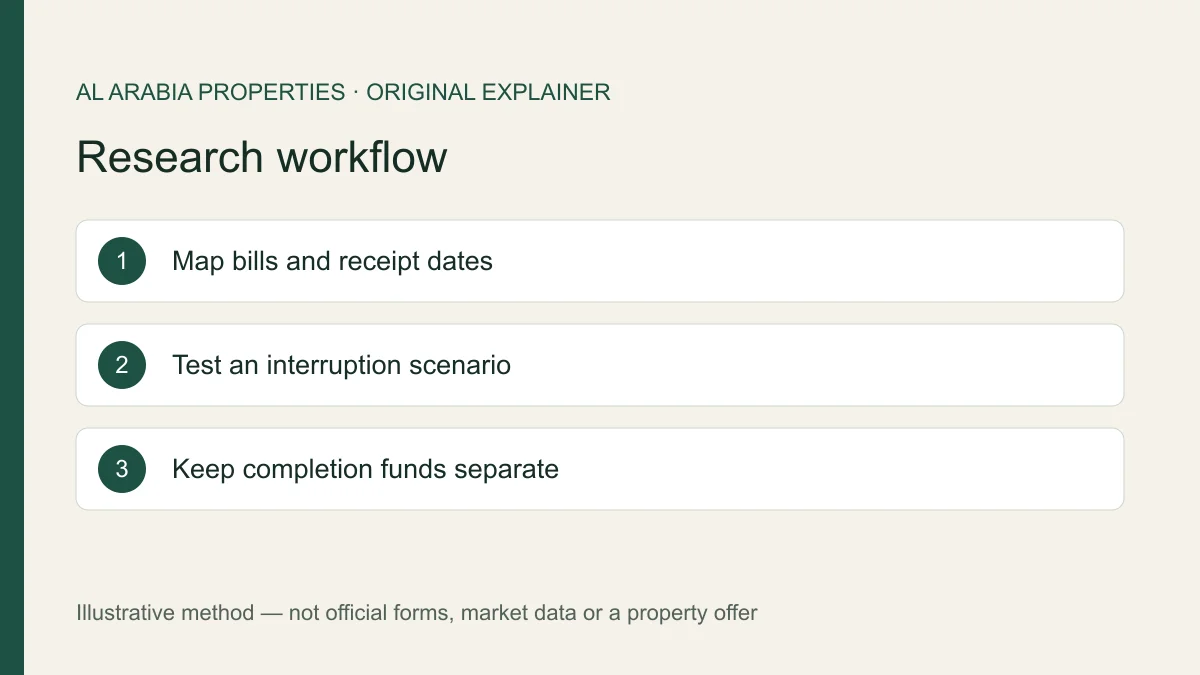
List each recurring obligation and its actual payment month. Include only costs that apply to the proposed asset: documented service charges, insurance where relevant, management arrangements, utilities you remain responsible for and agreed finance payments. Add likely change-of-tenant work as a separate assumption, supported by a quote when possible. Unknown costs belong in an unresolved column.
Distinguish a monthly equivalent from the date money leaves your account. A hypothetical annual charge of SAR 6,000 averages SAR 500 per month, but an upfront payment requires the full amount at once. If your model spreads every expense evenly, it can conceal the cash needed at the start of the year or immediately after completion.
Place expected rental receipts on the same calendar, using the actual proposed contract structure rather than an assumed monthly pattern. A receipt that is expected is not yet cash received. Also distinguish a delayed payment from an empty property: the cost pattern and remedial action may differ, even when both interrupt your planned income.
Run an explicitly illustrative stress test
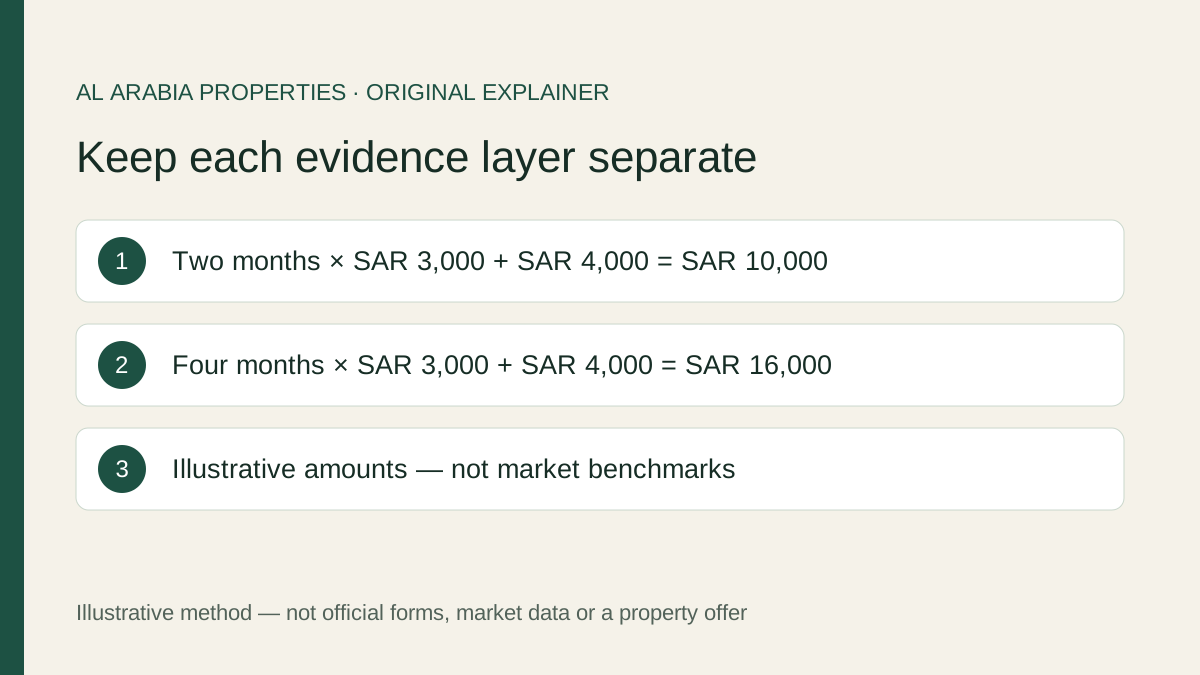
Suppose, only for illustration, that continuing obligations total SAR 3,000 per month and a tenancy change may require SAR 4,000 of one-off work. A two-month income interruption would require SAR 10,000 to cover those stated items: two times SAR 3,000, plus SAR 4,000. A four-month interruption would require SAR 16,000. These are arithmetic examples, not recommended reserves or measured vacancy rates.
Now add an illustrative SAR 6,000 annual charge that falls during the interruption. The first scenario becomes SAR 16,000 and the second becomes SAR 22,000. This shows why a reserve estimate should follow the payment calendar. It also shows why the same number of vacant months can create different cash needs depending on when the tenancy ends.
Separate the reserve needed to meet payments from the rent not earned. Forgone rent affects the economic outcome, but it is not automatically an additional cash payment. Counting it as both missing income and a separate payable expense can overstate the immediate liquidity requirement. Show the two measures in different columns so the reader can see the distinction.
Test repairs and uncertainty independently
Run more than one adverse scenario. Start with income interruption alone, then add a separately costed repair, and finally combine them. A combined scenario is useful because problems can occur together, but its assumptions should remain visible. Do not use a dramatic combined case as if it were the expected outcome or a prediction of local conditions.
For each assumption, record its source and sensitivity. A maintenance quote may apply only to one inspection finding. A management estimate may exclude materials. A financing schedule may change under its contract. Obtain transaction-specific clarification before treating a placeholder as a verified cost, and preserve the date of each supporting record.
Use the rental yield guide for the separate return calculation, and the completion budget guide for the money needed to complete a purchase. Avoid spending the same cash balance twice by describing it as both completion funds and an untouched operating reserve.
Compare choices without inventing market averages
When comparing two homes, use the same scenario periods and the same accounting categories. Differences should come from documented asset costs or clearly identified assumptions. A lower asking price may still involve larger immediate work or less predictable bills. A higher advertised rent does not resolve those obligations or establish that a tenant will be found on schedule.
Review the project comparison checklist and ownership cost guidance alongside your calendar. If the evidence is too incomplete for a comparable test, the practical next step is to obtain the missing records. Replacing them with optimistic estimates gives a numerical answer without solving the decision problem.
Broad economic reporting, including SAMA's report series, can provide context for research. It does not establish a vacancy assumption for a particular building or a reserve that suits your finances. Keep the official source separate from this original budgeting method. Your model should identify where local evidence ends and your chosen stress assumptions begin.
Set a decision rule before the purchase
Write down what would make the proposed commitment unmanageable. That might be a minimum cash balance you need to preserve for other obligations or an unresolved cost large enough to change the purchase decision. Determine the rule from your circumstances and professional advice where needed; do not choose it simply to make a shortlisted property pass.
Revisit the model after inspection, contract clarification and any updated cost quotation. Keep earlier versions so changes in your conclusion can be explained. Once owned, replace estimates with actual receipts and bills and reassess after a tenancy change. The value of the exercise lies in an honest, repeatable cash plan, not in producing one reassuring reserve number.
Sources and scope
- SAMA economic report series — checked 2026-09-29. Economic context only; this editorial scenario does not claim a market vacancy rate.