
Dadan: Reading AlUla’s Rock-Cut Archaeology
Read Dadan’s sandstone setting, rock-cut openings and material evidence, with four original photographs and clear limits on interpretation.

Dadan is an archaeological site in AlUla, in Saudi Arabia’s Madinah Region, where a sandstone cliff, rock-cut openings and settlement remains can be read together. Its interest extends beyond a recognizable photograph: the setting raises questions about how people shaped stone, organized a settlement and left material traces that researchers still examine. A rewarding introduction starts by separating what is visible from what requires archaeological evidence.
This guide, reviewed on 4 October 2026, focuses on landscape, carved form and the study of material remains. It offers an observation framework for readers and visitors, without assigning undocumented identities to tomb occupants or treating every visible feature as securely dated. The four photographs are separate original exposures of Dadan, not digital reconstructions of the ancient settlement.
Place Dadan within the AlUla valley
The archaeological study Towards a New Reference Dataset for Northwest Arabian Pottery, published on 9 March 2025, locates Dadan’s settlement mound on the eastern side of the AlUla valley, below the sandstone mountains of Jabal al-Khuraybah. That relationship between a settlement area and a prominent rock face is a useful starting point. Dadan should be understood as a place with ground-level archaeology as well as carved features higher in the stone.
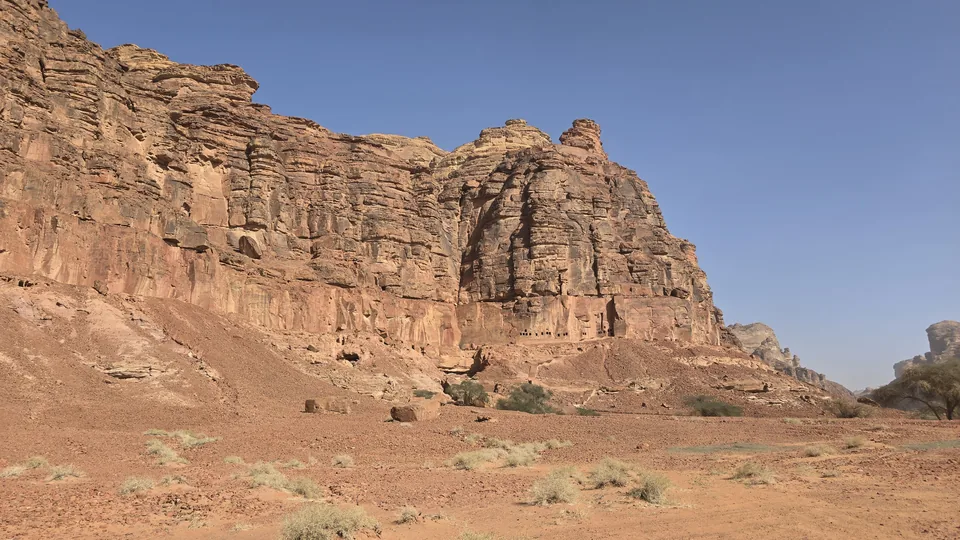
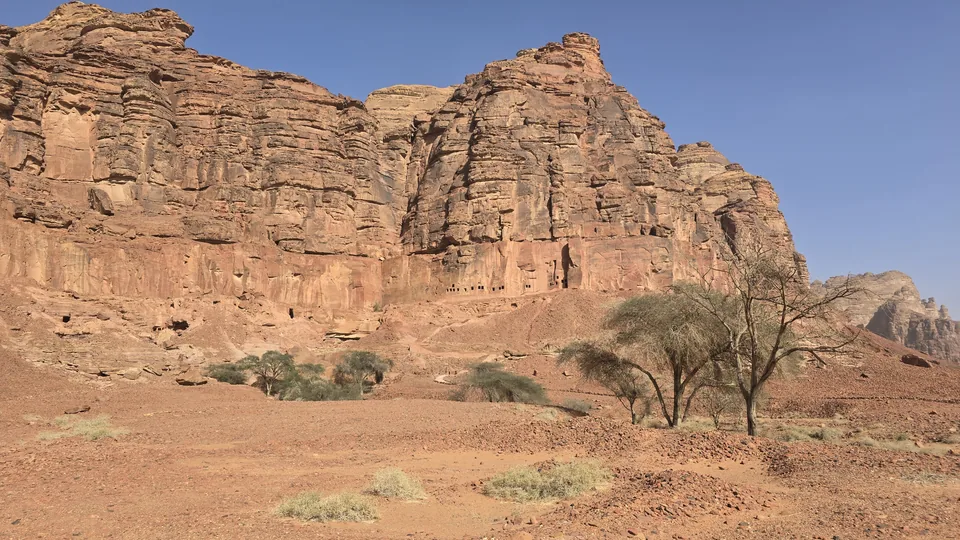
Look first at the broad setting rather than immediately isolating a decorative detail. In the photographs, the cliff occupies a large part of the view while rocky ground and vegetation provide a foreground. This combination helps explain why a close-up alone cannot represent the entire site. A tight frame describes a surface; a wider view shows where that surface sits.
For the larger geographic picture, the site’s guide to Madinah Region’s AlUla and Red Sea landscapes places inland heritage alongside the region’s different coastal setting. Geographic context makes the names easier to keep distinct when planning further reading.
Begin with the outline of the cliff
A broad view encourages attention to the cliff’s outline, its changes in height and the relationships between rock face, slope and ground. These are things a reader can observe without claiming to reconstruct an ancient route or the location of a vanished building. Describe the view using ordinary spatial language: openings are within the rock face, the foreground lies below them, and the cliff extends beyond the close-up frame.
The first distinction is between a feature’s appearance and an explanation for it. A shadow makes an opening easier to recognize but does not reveal its internal dimensions. A change in color can be visible without proving a change in age or function. Photographing the outline helps preserve the setting for later comparison with a verified site plan or explanation.
Avoid turning every irregularity into evidence of human activity. The carved rectangular openings can be described as deliberate forms, while an adjacent natural-looking edge may need a different explanation. A visitor’s task is to notice these contrasts and ask an informed question, rather than supply an unsupported answer.

Read the openings as a group
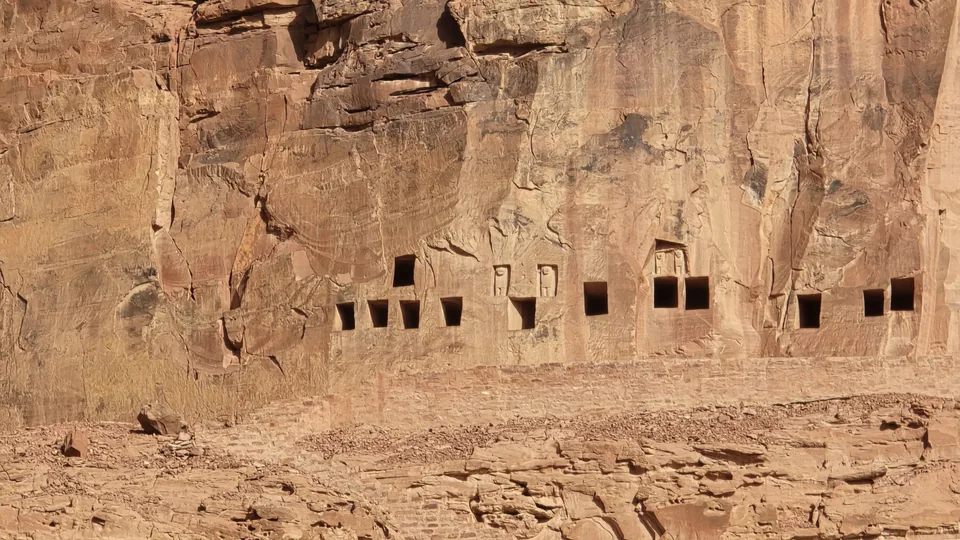
The official Experience AlUla Dadan page identifies the site’s rock-cut tombs and lion reliefs as prominent features. In the row photograph, several rectangular openings appear across the sandstone face. Some have visible carving above them; others present simpler outlines. Their arrangement is easier to appreciate when the entire group remains in the frame.
Compare width, height, spacing and surrounding surface visually without translating those observations into precise measurements. Perspective can make two openings appear more different than they are, and the photograph provides no calibrated scale. A statement such as one opening appears wider in this image is more defensible than assigning an unsupported dimension.
The group also prompts questions about variation. Were differences connected to the available rock surface, the working sequence, later alteration or another factor? Those alternatives require specialist evidence. Noticing variation is worthwhile even when the explanation remains open; it turns a familiar row of dark rectangles into a set of material questions.
Look closely at the lion reliefs
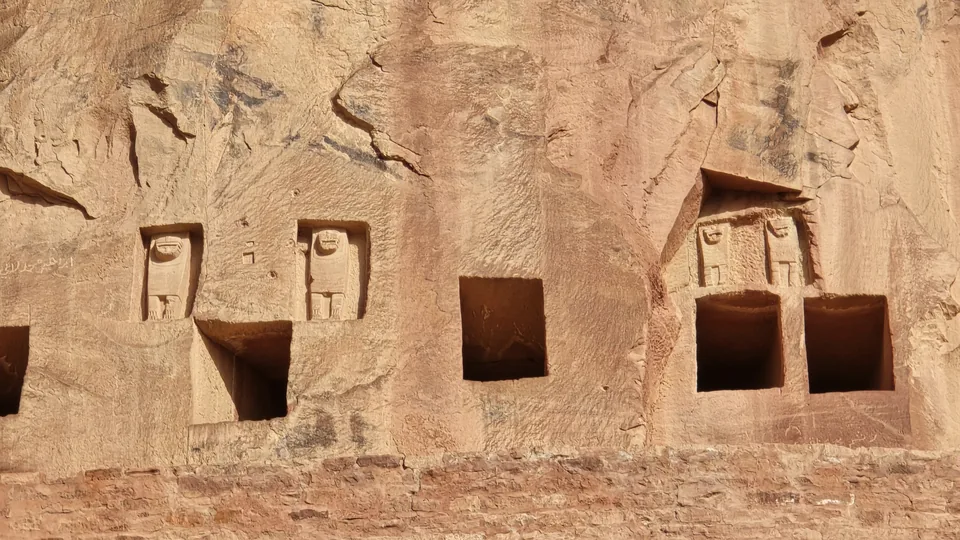
The close photograph shows lion forms carved above selected openings. A relief remains connected to the surrounding rock surface, rather than standing as a separate object in the foreground. Looking at its relationship to the opening below it helps the reader describe the carving without inventing a story about the people associated with the tomb.
Observe the outline, the position within the surrounding panel and the way light falls across the surface. A shallow feature may become more visible under side lighting, while a front-lit photograph may suppress its depth. That difference belongs to the viewing conditions as well as to the carving. A photograph should not be treated as a complete record of everything present on the stone.
Keep a clear boundary between description and interpretation. The visible presence of a lion form can be recorded; an explanation of its meaning needs an appropriately supported source. This guide does not attribute the reliefs to a named occupant or social group. The carving itself provides enough material for careful observation of form, placement and technique.

Understand what a rock-cut space changes
A rock-cut opening is made within an existing mass of stone. That basic distinction helps explain why its relationship to the cliff matters. Unlike a freestanding facade viewed in isolation, the cut space shares its setting with the surrounding rock. The outer surface and the opening can be studied together, even when the interior is not visible or accessible.
This observation does not establish how long the work took, which tools were used on a particular opening or how an internal space was finished. Those are research questions. From an authorized viewing position, focus on the observable boundary between the natural mass and the deliberately shaped outline. Avoid equating the darkness inside an opening with a known depth.
A useful comparison exercise is to describe the same feature twice: once as a close detail and once within the wider cliff. The first description might emphasize a rectangular edge and a relief panel. The second might emphasize the opening’s position above the ground and among neighboring forms. Together they convey more of the place while remaining within the evidence of the view.
Settlement remains need a different way of looking
The cliff is visually prominent, but archaeological understanding cannot stop at the most photogenic feature. Research about Dadan also addresses deposits, buildings and finds in settlement areas. Those forms of evidence ask a reader to think about relationships between objects and their recorded locations, rather than simply comparing visible facades.
The original research article Bridging the Late Antique Gap in Northwest Arabia, first published on 24 November 2025, reports excavations of a settlement south of ancient Dadan. It combines several specialisms, including the study of pottery, plant remains, animal remains and geological context. The report concerns a defined research area and sequence; it should not be flattened into a claim that every part of Dadan belongs to one period.
For a general reader, the significance is methodological. A place can contain evidence from different stages of occupation, and separate research areas may answer different questions. A date attached to one deposit or building cannot automatically date every visible opening in a distant cliff face.
Why pottery deserves attention
The March 2025 pottery study classifies material from Dadan using visible fabric characteristics, together with observations about making, shapes and decoration. Its results are described as preliminary, and several interpretations await further analyses. This is a useful reminder that an apparently modest fragment can be part of a carefully bounded research question rather than a finished account of the whole settlement.
Think of a pottery fragment as an object with several potentially informative qualities. Its surface appearance is one aspect; its shape and the place where it was recorded are others. A decorative detail can attract attention without being the only feature relevant to research. A visitor need not memorize technical classifications to appreciate that distinction.
If a display includes pottery, read the label’s explanation of where the object came from and what is known about it. Keep tentative language when repeating a tentative conclusion. A comparison suggested by researchers should not become a certainty simply because the display presents the fragment clearly and attractively.

Context explains more than an isolated object
An isolated photograph of a find can show its form well while leaving its archaeological context invisible. Context includes the recorded relationship between a find and the surrounding deposit or structure. That relationship is one reason careful documentation matters: the object and the evidence about its position contribute different information.
For readers, a useful question is whether an interpretation relies on the object itself, its recorded location, comparison with other material, or a combination of these. An image caption may answer the first question without answering the rest. Distinguishing those roles helps a reader understand why a research paper can be cautious even when a photographed object seems immediately recognizable.
It also suggests a sensible way to read an exhibition. Start with what the label actually says, then note the method or evidence it identifies. Avoid extending a claim beyond the object or group discussed. A clearly described fragment from one recorded context should remain attached to that context when it is summarized in a personal note.
Keep Dadan distinct from nearby heritage places
Dadan, Hegra and AlUla Old Town are different places within a broader destination. Their proximity in travel discussions does not make their visible remains interchangeable. A photograph of one should never illustrate a claim about another without clearly identifying its purpose. The same applies to dates, inscriptions and architectural details.
Our introduction to AlUla Old Town and Hegra explains why those two heritage settings should be read separately. Use it as a comparison after studying Dadan, rather than as a replacement for Dadan’s own evidence. A useful reader’s notebook gives each site its own heading and keeps the relevant images beneath it.
For regional orientation, the Madinah Region overview is another suitable next reading. Moving between a regional overview and a specific archaeological site lets a reader understand both location and material detail without confusing a destination label with a single uniform historical setting.
Use photographs as records of a view
The four photographs in this article show a row of openings, a wide cliff view, a cliff-and-tree view and a closer view of carved reliefs. Each frame selects a different relationship. The row makes repetition and variation visible; the wider views restore the landscape; the close view makes individual carved forms easier to examine. None is a complete site survey.
When taking permitted photographs, record the place, date and viewing position as accurately as possible. Keep an image’s purpose modest. It may preserve what was visible from that position, but it cannot authenticate an unseen interior or replace a measured archaeological drawing. Do not label a natural-looking line as a tool mark without evidence supporting that identification.
Comparing a close image with a wide image is especially useful. It prevents a visually compelling detail from becoming detached from the cliff around it. It also helps readers recognize that changes in framing, perspective and light can affect their impression of the same physical feature.
Plan a visit through current official information
Check the official Dadan page for the available visit format and current arrangements before traveling. This article does not fix a ticket price, departure schedule, access route or refund condition. Those practical details can change, and a general heritage introduction should not present an earlier arrangement as a guaranteed service on a future date.
Follow the site’s current instructions and authorized route. Do not assume that a visible opening is available to enter or that a photograph showing a close view authorizes approaching the same position. A better view is not a reason to touch a carved surface, remove a loose object or step across a restricted area. Direct questions about access to the responsible on-site staff.
Accessibility questions also deserve a specific answer before booking. Ask about the actual surface, transfers and viewing arrangements relevant to your needs, rather than inferring them from a distant landscape photograph. The official information and an explicit response about the current visit are more useful than a broad promise that every visitor can see every feature in the same way.
Leave with three well-framed questions
A good introduction to Dadan can end with questions rather than a memorized list of claims. Ask how the carved openings relate to the cliff around them, what evidence connects the settlement remains to particular periods, and how researchers distinguish observation from interpretation. These questions remain useful whether the next step is another article, an exhibition label or an authorized site visit.
Write a short note separating visible details, source-backed explanations and unresolved points. For example, a rectangular opening is visible in the photograph; the identification of the site’s tombs comes from the official source; the particular history of an individual opening may require further research. Keeping those statements separate makes the note more reliable and easier to update.
Dadan rewards this slower reading because the place is more than a single facade. Stone, setting and recorded material evidence each contribute something different. Begin with the landscape, attend to the carved forms, and let research explain what the photographs alone cannot establish. That approach preserves the interest of the site while giving its evidence the care it deserves.
Sources and review
- Experience AlUla: Dadan — reviewed 4 October 2026. Official place information and current visit guidance.
- Shabo, Rohmer and Tourtet: Dadan pottery study — reviewed 4 October 2026. First published 9 March 2025; pottery fabric study and preliminary findings.
- Rohmer and colleagues: Late Antique archaeology near Dadan — reviewed 4 October 2026. First published 24 November 2025; spatial research in a defined settlement area.