
Rajajil Standing Stones: Reading the Evidence
Understand Rajajil near Sakaka through stone groups, dating and burial evidence, with source-linked explanations and thoughtful archaeological observation.
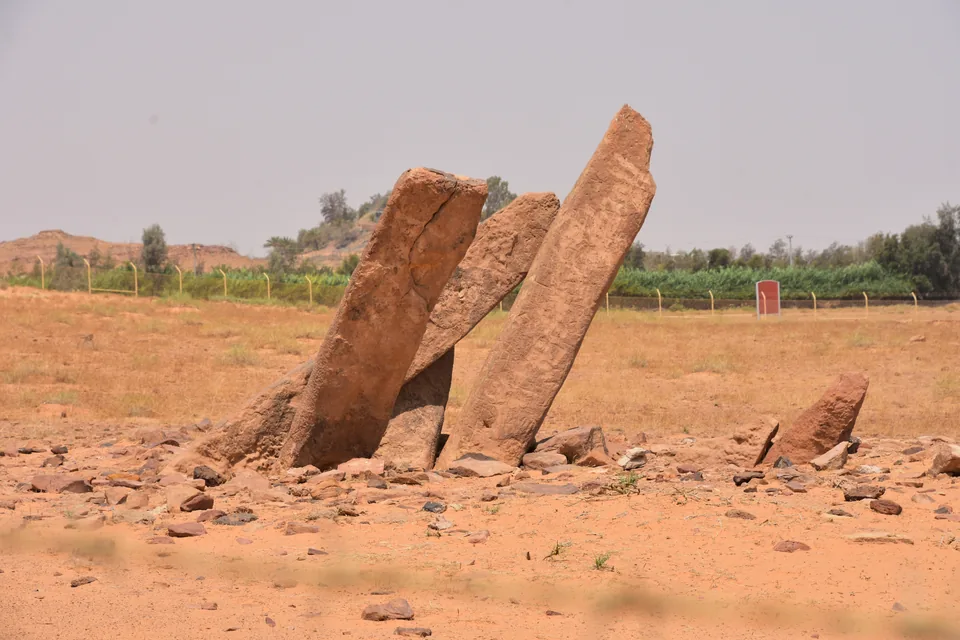

Rajajil is a prehistoric standing-stone site near Sakaka in Saudi Arabia’s Al Jawf Region. Its sandstone columns are striking, but understanding them requires more than a dramatic photograph: the stones, surrounding archaeological deposits and excavation records provide different kinds of evidence. The most rewarding question is how those pieces fit together, rather than whether Rajajil deserves a comparison with another country’s famous monument.
This guide explains what a reader can observe, what published sources report, and where interpretation remains open. It treats Rajajil as a place with its own history. It does not present a disputed age as an exact construction date or turn an apparent alignment into proof of an observatory. Sources were reviewed on 4 October 2026; historical publication dates remain identified below. Current opening arrangements require separate confirmation.
Begin with the wider Al Jawf Region guide if the location is unfamiliar. Then use the following sections to read the monument at three scales: an individual stone, a group of stones, and the landscape containing them.
Locate Rajajil within Al Jawf
Saudipedia’s December 2022 reference places Rajajil approximately ten kilometres southeast of Sakaka. Its local name refers to a gathering of men, reflecting how upright stones can resemble human figures from a distance. That is a useful introduction to the site’s appearance, rather than an explanation of the builders’ purpose.
Keep the archaeological site and the modern city distinct when planning your reading. A photograph labelled Sakaka may show a castle, a street, a well or Rajajil; those subjects do not share one date or function. The Sakaka city guide supplies orientation without making the columns an urban building.
At landscape scale, note the contrast between vertical stones and the low surrounding ground. A tall object becomes a visual reference even when its individual surface is difficult to see. At group scale, attention shifts to spacing and differences in height. At stone scale, shape, edges and marks become visible. Each view answers a different question, so a close photograph alone cannot explain the whole arrangement.

Read groups and gaps together
SPA’s report of 18 September 2025 describes around fifty groups of sandstone columns, with some reaching approximately three metres. These are rounded descriptive figures from that report, not a fresh survey performed for this article. In particular, groups and individual stones are different counting units.
That distinction changes how a reader imagines the monument. A statement about fifty groups should not become a statement that fifty stones survive. Nor should a photograph of three standing slabs imply that every group originally contained three. A frame may exclude fallen stones, hide one behind another or show only a portion of an arrangement.
Look at gaps as carefully as the uprights. An open interval could reflect original spacing, a missing element, the viewing angle or a different group beyond the frame. Deciding between those possibilities requires a plan and evidence about the monument’s history. The shape seen today is an observation; a reconstructed original layout is an interpretation.
Try comparing two photographs without counting across them. Describe each separately, recording the visible standing stones, fallen slabs and uncertain edges of the group. Only combine counts when the images’ locations and overlap are known. This simple discipline prevents one striking cluster from becoming an imaginary map of the entire site.

Separate an age from a construction date
Readers will encounter several descriptions of Rajajil’s age. The 2025 SPA account uses an estimate of around 6,500 years. Saudipedia’s dedicated reference mentions older archaeological findings, associates the columns with the fourth millennium BCE, and supplies a different date in its information box. Those formulations should be read as source-specific descriptions, rather than compressed into one supposedly exact year.
An archaeological place can contain evidence from more than one episode. The age of a recovered object, a burial, an occupation layer and a standing structure need not be identical. Finding early material at a site does not automatically date every visible column. Equally, a later mark on a stone need not establish when the stone was first erected.
The National Park Service’s explanation of dating methods, updated in May 2023, distinguishes relative sequences from estimates of intervals in time. Radiocarbon dating examines organic material, such as bone or charcoal; it does not directly read a construction year from a sandstone photograph. These are general methodological principles, not new measurements at Rajajil.
When comparing age claims, ask what was dated, where it came from, and how securely it relates to the feature under discussion. A dated sample becomes more useful when its association is explained. A large number without those details may communicate antiquity, but it cannot carry the weight of a precise architectural chronology.
Understand the burial evidence carefully
The German Archaeological Institute’s project account reports small-scale excavation at Rajajil in 2012 and recovery of disarticulated human remains from the area of a looted cairn grave. This is important evidence of a burial context within the archaeological site. It is more specific than an unsupported claim that the stones’ purpose is entirely unknown.
However, the same account discusses several locations, including sites in southeastern Jordan. Its radiocarbon range of 3633–3375 BCE belongs to a human-bone fragment from a named tomb at Wadi Sahab al-Asmar in Jordan. It must not be transferred to the Rajajil columns merely because both places appear on the same project page.
This illustrates a common reading problem. A research project can compare related practices across locations, while each excavation and sample retains its own provenance. A date in the next sentence is not necessarily the date of the monument mentioned in the previous one. Follow the place name, sample and feature through the entire description.
Burial evidence also does not require every stone group to have had an identical role. The published project overview is a concise account, not a complete visitor-facing reconstruction of all structures. A careful explanation can acknowledge funerary evidence while leaving the relationship between particular groups, deposits and activities to detailed archaeological investigation.
Treat alignment as a question
Descriptions of Rajajil often draw attention to the orientation of the columns. Saudipedia refers to alignment towards sunrise and sunset. That reported relationship gives readers a question worth investigating; it does not by itself establish a calendar, an observatory or one specific ceremony.
To assess an astronomical interpretation, one would need more than the direction a photograph seems to face. Relevant questions include which features define the proposed line, how their original positions were established, and which horizon or celestial event is being considered. The comparison also needs to explain whether the arrangement is intentional and how alternative interpretations were tested.
Consider an ordinary photographic example. Two stones appear perfectly aligned when the camera stands behind one of them. Moving sideways separates their silhouettes. Neither view alone records a surveyed orientation. Perspective creates a visual relationship, whereas an archaeological alignment claim requires measurements and context beyond that visual impression.
Keep the language proportionate to the evidence available. A source reports an orientation; a reader observes a row; a researcher proposes an astronomical function. Those are different statements. Naming the type of statement helps preserve the interest of the monument without filling missing evidence with certainty. Rajajil remains compelling even when its interpretation is presented as an active archaeological question.
Look closely without decoding from a photograph
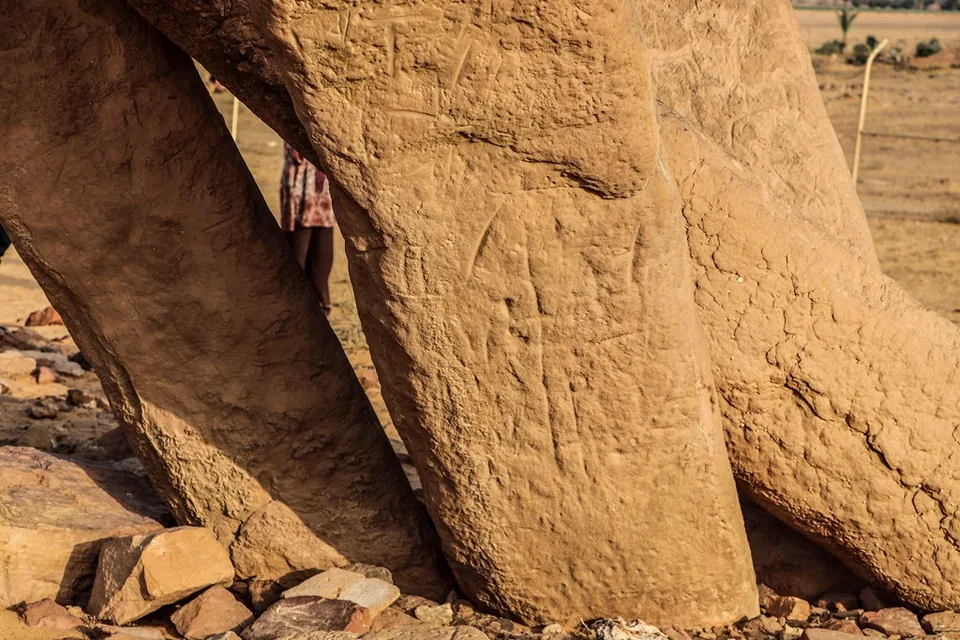
The marked-stone photograph in this article offers a different encounter with Rajajil from the wider views. Incised lines attract attention to the surface, while weathering, light and the angle of the slab affect how clearly individual marks can be seen. The image is useful for observing the stone, not for assigning a language, translation or date.
Begin with a plain description: where the marks lie on the visible face, whether they form clusters, and which edges are obscured. Avoid tracing an apparent character into a confident reading. Specialist documentation may need better lighting, multiple views, measured drawings and comparison with established scripts. A casual resemblance is not enough to identify an inscription.
The surrounding stone matters too. A mark on an upright slab could relate to an episode different from its initial placement. Explaining that possibility does not declare that the visible marks are later; it shows why the relationship must be demonstrated. One surface can attract attention at different times without preserving a written account of every encounter.
For your own notes, separate observation and inference into two sentences. Record that lines are visible on the photographed face. Then record that their meaning and chronology have not been established by the image. This method produces a useful description that can later be checked against an authoritative interpretation, rather than a story that becomes difficult to correct.

Include fallen stones and surrounding ground
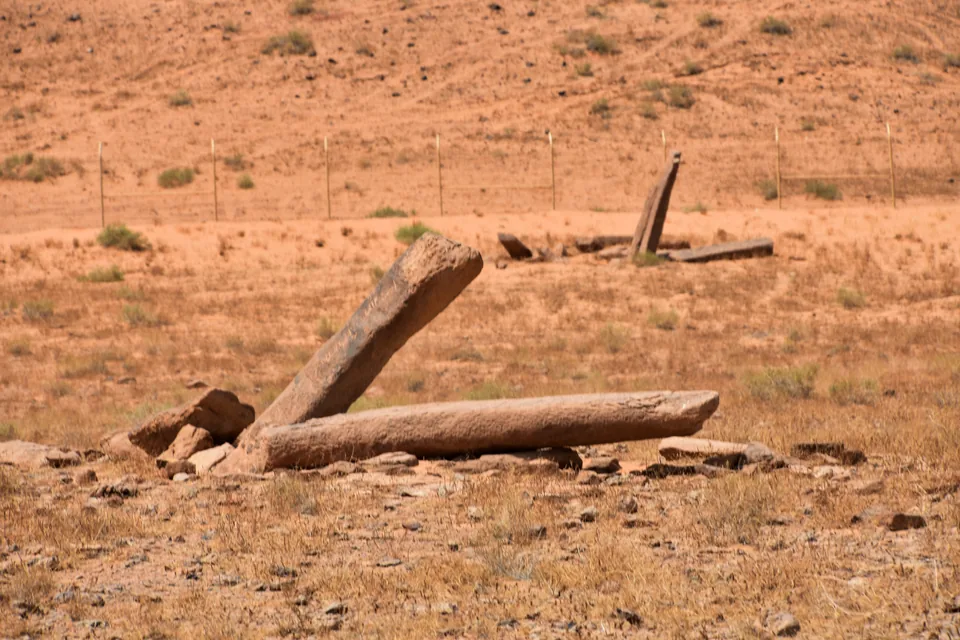
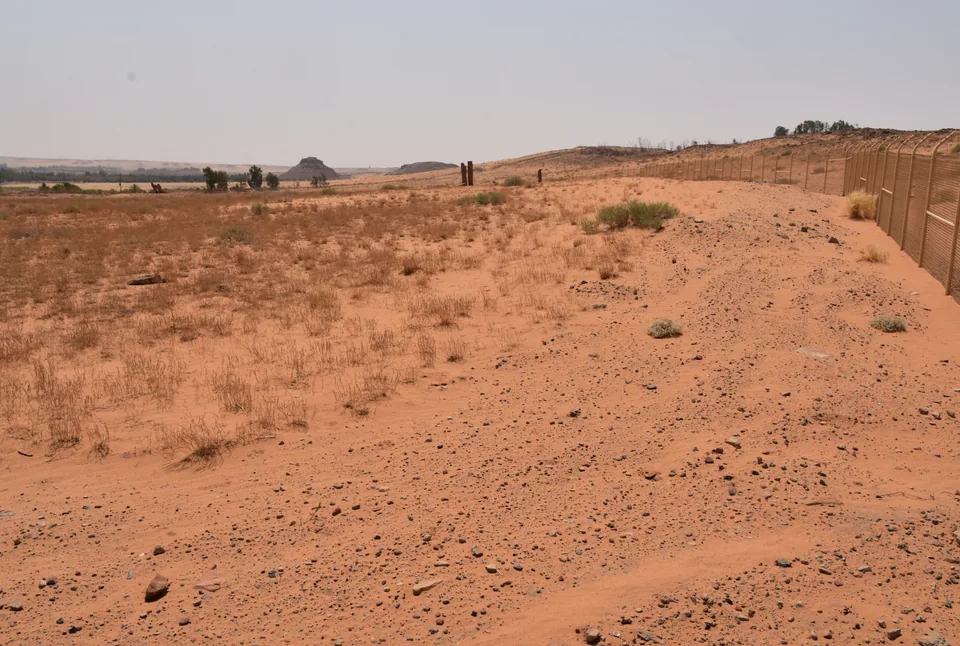
An upright column dominates a photograph, but fallen slabs and ground-level remains also belong in the reading. Notice whether a slab is partly buried, lies beside an upright or appears beyond the main group. Those relationships may be relevant to a documented plan, even when their explanation is unavailable to a visitor.
Do not turn visible leaning into a diagnosis. An image cannot show whether movement occurred recently, in antiquity or through more than one process. It also cannot demonstrate that a particular stone is safe to approach or touch. The appropriate response is to observe from permitted areas and leave assessment and intervention to the responsible specialists.
The NPS introduction to archaeological context explains why objects gain meaning through their spatial, chronological and other associations. At an archaeological place, the surrounding evidence may be less photogenic than a monument but just as important to interpretation. This general principle supports careful observation rather than collecting or rearranging anything.
A hypothetical example makes the issue clear. A small fragment photographed beside a slab has one recorded relationship. If someone moves it for a cleaner composition, the next photograph records a different relationship. Leave stones and fragments where they are; avoid climbing, rubbing, marking or staging objects for photographs. Follow the site’s actual instructions and barriers.
Place Rajajil beside other regional heritage
Saudipedia’s regional antiquities account describes a broad archaeological landscape, including prehistoric material, rock inscriptions and later monuments. That variety is a reason to compare places thoughtfully. Al Jawf’s heritage is not one uniform era represented by interchangeable ruins.
The existing Sakaka and Dumat Al Jandal castles article introduces another way to read built form. A fortress prompts questions about walls, access and elevated position. Rajajil prompts questions about stone settings, their surroundings and archaeological associations. Applying a castle’s architectural vocabulary to the standing stones would obscure the differences rather than explain them.
Use comparison to sharpen questions, not to import conclusions. What survives above ground? What evidence depends on excavation? Which details belong to the structure and which belong to later presentation? The same questions work across locations, but the answers must remain particular to each place.
Prepare a useful visit or reading session
Treat present access as a practical question separate from historical significance. Before travelling, confirm the correct location, current visiting arrangements, permitted areas and any requirements with an official tourism or heritage contact. An older photograph showing a fence or open ground cannot establish today’s entrance, operating hours, facilities or accessibility.
Choose a manageable reading goal. You might compare the grouped columns with the fallen slabs, or examine how a marked face differs from a wider landscape view. A focused question is more productive than trying to solve the monument’s entire history during one stop. Use available official interpretation and retain its date or publication details in your notes.
Build a short record with four parts: the place and viewing position, the visible feature, the published explanation, and the remaining question. For example, you can describe a leaning group, note the source’s terminology, and ask how a plan identifies its relationship to nearby remains. That record preserves useful observations without inventing measurements or excavation findings.
The next reading should follow the question you still have. Return to the primary excavation account for burial context, the dating-methods reference for chronology, or the Al Jawf guides for geographic and architectural comparison. Rajajil rewards this patient approach: its stones provide an arresting first impression, while careful attention to evidence makes the place more meaningful long after the photograph has been taken.
Sources and review
- Saudipedia: Columns of Rajajil — reviewed 4 October 2026. 14 December 2022; site location, appearance and reported finds. Its varied chronology is discussed above.
- SPA: Al-Jouf Region’s Historic Sites — reviewed 4 October 2026. 18 September 2025; historical reporting on Al Jawf, not a current access notice.
- German Archaeological Institute: Broken, Burned and Buried — reviewed 4 October 2026. Primary excavation account: Rajajil in 2012. The Jordanian dated sample is kept separate.
- NPS: How Do Archeologists Date Sites and Artifacts? — reviewed 4 October 2026. Updated 9 May 2023; general dating methods, not measurements at Rajajil.
- NPS: What Is Archeological Context? — reviewed 4 October 2026. Updated 9 May 2023; general principles for archaeological context.
- Saudipedia: Antiquities in al-Jawf Province — reviewed 4 October 2026. 9 February 2021; regional archaeological background.