
Dhee Ayn Heritage Village: Stone, Water and Landscape
Read Dhee Ayn heritage village in Al Baha through its stone houses, rocky ridge and water landscape, with clear heritage status and thoughtful visitor checks.
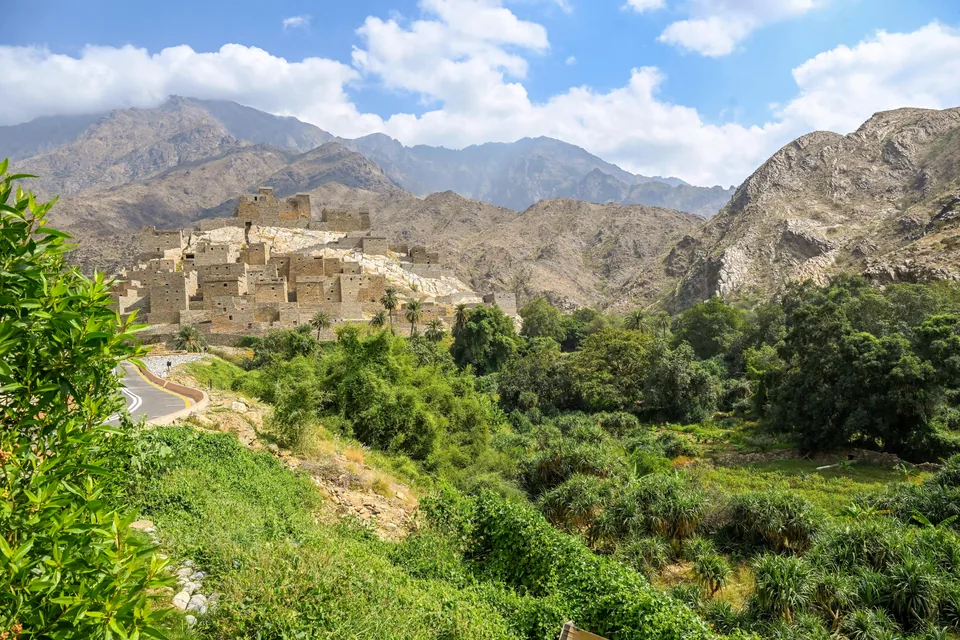

Dhee Ayn is a stone heritage village in Al Baha Region, southwest Saudi Arabia, where stacked houses, a pale rocky ridge and surrounding vegetation form one distinctive landscape. Read it from the outside inward: first notice the settlement's position, then its walls and passages, and finally its relationship with water and cultivated ground. This makes a visit more rewarding than collecting a single photograph of the place commonly called the Marble Village.
English spellings include Dhee Ayn, Thee Ain, Dhi Ayn and Zee Ain. UNESCO's Tentative List entry uses Zee Ain and identifies the Al-Makhwah area of Al Baha Region. Start with our Al Baha Region guide to distinguish the wider region from Al Baha city and the village itself.
Begin with the ridge and the whole settlement
From an authorised viewpoint, compare the pale exposed rock with the darker stone buildings. The first photograph shows the village above green vegetation, with mountain slopes behind it. Notice the contrast in texture as well as colour: an irregular natural surface below, repeated openings and wall edges above. These are observations from the photograph, rather than a claim that every facade has the same material or condition.
The Marble Village nickname can be misleading if understood as a promise of polished marble houses. Visit Saudi's official summer guide uses the nickname while describing flat-stone construction. Treat the name as an introduction to the striking setting; a geological identification of each building stone would need separate evidence. Looking closely is more useful than letting the nickname answer every question.
Try a simple observation exercise. Find the apparent base of one building, follow its corners upward, then look for the route beside it. Repeat this with a neighbouring house. The exercise helps separate individual structures from the mass of the settlement. It does not require entering a building or crossing a barrier, and it avoids assuming that a continuous wall belongs to just one household.

Look for the work of stone construction
Saudipedia's traditional architecture overview for Al Baha, dated 7 October 2024, describes locally sourced stone, timber and other materials across the province. It identifies Dhi Ayn's multi-storey stone houses within that regional tradition. Regional descriptions provide context; they should not be used to assign the same construction detail to every visible wall in the village.
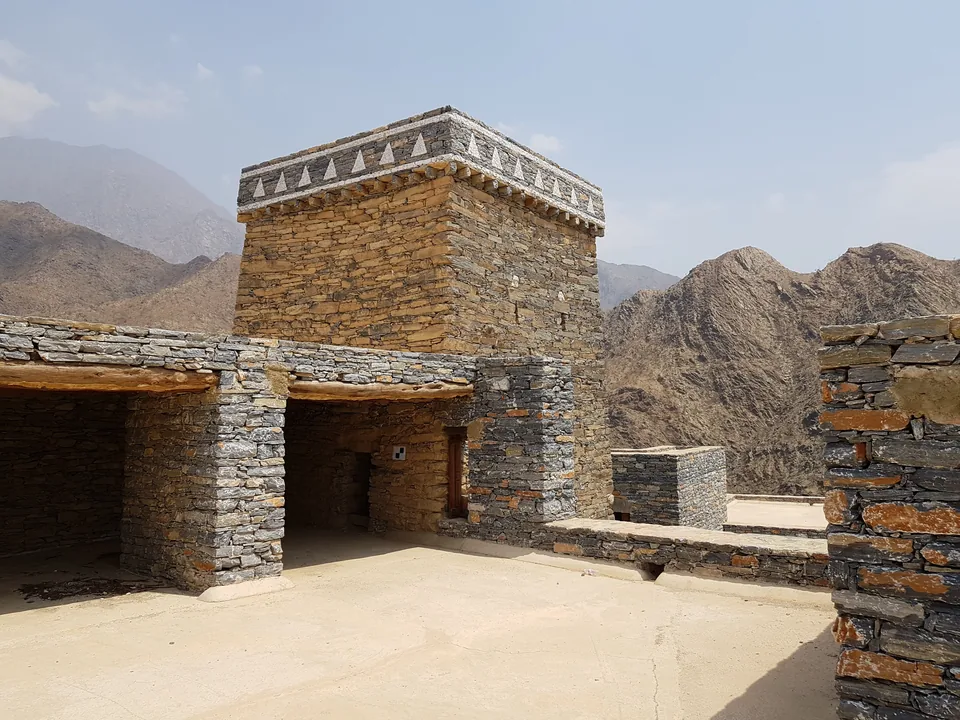
The second photograph offers a closer view of a stone tower and adjoining openings. Compare the smaller stones between larger pieces, the edges around doorways and the pale geometric band near the top. A visitor can use these visible details to ask how builders made a surface regular while working with irregular pieces. The photograph alone cannot establish when a particular feature was added or restored.
This is a useful comparison with Rijal Almaa's stone houses. Both guides invite attention to stone, openings and mountainous surroundings, but the settlements have separate histories. Keep your notes place-specific: record which village and which facade you observed instead of merging them into a generic Saudi mountain-house style.
Understand water as part of the heritage
The 2015 Saudi submission published on UNESCO's Tentative List connects the village's name with a spring and describes surrounding farms. Water is therefore part of the historical account, alongside the houses. The vegetation visible in the landscape photograph gives a starting point for thinking about that relationship; it does not prove today's flow, water quality or access to a particular channel.
Ask three connected questions while reading an on-site explanation: where did water enter the cultivated area, how was it distributed, and how did the settlement relate to the productive ground? These questions turn a scenic contrast into a clearer account of daily life. Follow the site's interpretation rather than reconstructing a complete irrigation system from a distant view.
Cultivated ground also deserves consideration as someone's working space. View gardens from permitted routes, ask before entering and leave plants and channels undisturbed. If local produce is offered during your visit, confirm the seller's description rather than assuming everything nearby was grown within the heritage village. A photograph and a place name cannot establish the origin of a product.
Keep heritage status and historical precision clear
As checked on 3 October 2026, UNESCO's Saudi Arabia country page lists Zee Ain among tentative properties, rather than inscribed World Heritage properties. The village's submission date is 8 April 2015. Tentative-list inclusion records a country's potential nomination interest; it is not World Heritage inscription. Use that distinction when describing the visit or sharing photographs.
Published descriptions also differ in their building counts and historical dating. The tentative entry itself contains inconsistent counts and calendar wording, while other official reference descriptions give different totals. This guide therefore avoids an exact house count or founding year. Ask whether an on-site figure refers to surviving buildings, dwellings, restored structures or the historical settlement before repeating it as a precise fact.
For a material comparison, explore our Diriyah earthen architecture guide. Contrasting stone and earth encourages better questions about local building choices. It does not make one settlement older, more authentic or more valuable than another.
Plan a visit that leaves time to observe
Visit Saudi maintains separate pages for Thee Ain Historical Village and its visitor centre. Check current arrangements before travelling. Seasonal guides and older photographs do not establish today's opening hours, admission conditions or which interiors are accessible.
- Confirm the destination pin and the route from your actual starting point; avoid treating straight-line distance as journey time.
- Ask about stairs, surfaces, resting places and the route from arrival to the areas your group wants to see.
- Choose footwear for uneven surfaces and carry what your group needs for the day's conditions.
- Follow marked access and staff instructions, and request permission before photographing people at close range.
Our Al Baha forest outing guide helps plan a separate nature stop. Keep it optional so the heritage visit retains time for observation. Leave with three useful notes: one about the ridge, one about a construction detail, and one question about water or everyday life to investigate further.
Sources and review
- UNESCO: Zee Ain Tentative List submission — reviewed 3 October 2026. Saudi submission dated 8 April 2015. Location, spring and farm relationship; historical counts and calendar wording conflict, so no exact founding year or count asserted.
- UNESCO: Saudi Arabia current property lists — reviewed 3 October 2026. Zee Ain remains on the Tentative List, separate from World Heritage inscription; checked 3 October 2026.
- Saudipedia: Traditional Architecture in al-Bahah Province — reviewed 3 October 2026. Dated 7 October 2024. Regional materials and multi-storey stone architecture; conflicting exact house count omitted.
- Visit Saudi: Saudi Summer Guide — reviewed 3 October 2026. Official guide uses Marble Village nickname and describes flat-stone construction. Seasonal hours and events are not current access promises.
- Visit Saudi: Thee Ain Historical Village — reviewed 3 October 2026. Current official destination reference, not a verified guarantee of hours, interiors, prices or accessibility.
- Visit Saudi: Thee Ain Heritage Village Visitor Center — reviewed 3 October 2026. Separate official visitor-centre reference; current practical arrangements should be confirmed before travel.